

Digestibility refers to the proportion of dietary nutrients that your cat can break down, absorb, and use in his body. Many factors impact how the ingredients and nutrients in food are absorbed, and this, in turn, can impact our cats’ health.
For the average healthy cat, any complete and balanced cat food will provide the nutrients he needs. But cats with chronic gastrointestinal issues may need a more digestible or gut-friendly diet to support their health and prevent the dreaded vomiting and diarrhea.
“Digestibility has to do with the mineral content and fiber in food,” says Joseph J. Wakshlag, Ph.D., DVM, ACVN, ACVSMR, Professor of Clinical Nutrition and Sports Medicine and Rehabilitation at Cornell University’s College of Veterinary Medicine. “The mineral content is often not all absorbed, so higher is less absorbable and fiber cannot be digested in general, and both lead to decreased digestibility. Then there is the cooking of the food via retort and extrusion processes, which will destroy protein to some degree, making it less digestible in general.” Importantly, such infections may also occur in healthy cats.
Not Everything Is Digested
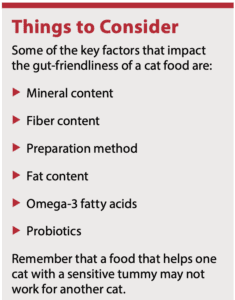
Minerals and fiber are important for your cat but are also difficult or impossible to digest. These are cases where digestibility does not correlate with gut-friendliness. Higher mineral or fiber content in a diet will result in lower digestibility of that food. This is why no complete and balanced cat food will have 100% digestibility. That’s OK. Minerals are necessary for your cat to stay healthy, and fiber supports his GI health.
Fiber promotes gut motility, or the movement of food through the digestive tract. It “bulks up” your cat’s stool to encourage normal bowel movements. This is why your veterinarian may recommend a higher fiber diet if your cat is experiencing diarrhea.
Some sources of fiber are also prebiotics. Prebiotics are the “food” for your cat’s microbiome, the army of bacteria that live in his GI tract and help him to break down food. Feeding prebiotics helps to support normal gut flora, which in turn supports digestion and overall health of the cat.
Preparation Method
How a cat food is made matters. “Across the board, fresh and raw foods tend to be more digestible in the literature,” says Dr. Wakshlag. “It all comes down to the quality and refined nature along with the processing that can influence digestibility. There is a range of digestibility from about 75% up to 90% on average for organic matter digestibility.”
Each food type has its pros and cons, and the quality of individual ingredients will also play a role in any food’s digestibility.
For the average cat, any complete and balanced kibble or canned food will still provide everything he needs. These foods are readily available and affordable.
Fresh cooked foods are generally more highly digestible but also come with a higher price tag.
Raw foods also tend to be more highly digestible and come with a higher price tag. Raw foods also have a much higher risk of contamination, making them a poor choice for sick cats who are already immunocompromised and vulnerable to bacterial and parasitic infections.
Hydrolyzed foods are highly digestible and have the added benefit of being prescription diets (these diets go through extensive testing). In a hydrolyzed diet, the proteins are broken down into small pieces or amino acids that are very easy for the body to absorb and use. Your veterinarian might recommend a prescription hydrolyzed diet if your cat has chronic GI issues that have not responded to treatment or if he has a food allergy.
Fat Content
Fat is important for your cat, but it also takes a fair amount of effort to absorb and slows gut motility. Rich, high-fat foods may cause diarrhea or soft stools in some cats. Your veterinarian may recommend feeding lower-fat food for a few days if your cat is experiencing GI upset or may recommend trying a low-fat diet long term if your cat has chronic diarrhea.
Omega-3 Fatty Acids
Omega-3 fatty acids interact with our cats’ bodies in complex ways and have many benefits. In the GI tract, omega-3 fatty acids help to modulate inflammation, maintain intestinal wall integrity, and support a normal gut microbiome, all of which improve digestion. While increased levels of omega-3 fatty acids do not make the food more or less digestible, they do support better function of the digestive tract.
Probiotics
Probiotics are another factor that do not impact digestibility, but they do impact gut health. Probiotics are the “good” bacteria that normally live in your cat’s gastrointestinal tract and help him break down and use the food he eats.
Your cat’s microbiome can be compromised in many different ways, including infection from a pathological bacteria that makes him sick or antibiotics wiping out the beneficial bacteria. The microbiome is also impacted by what your cat eats. Giving probiotics can help to rebalance the microbiome and promote gut health. This is why your veterinarian may prescribe probiotics when your cat has diarrhea.
If your cat also gets prebiotic fiber, even better. The probiotics increase the good bacteria in the gut, and the prebiotics will ensure they have plenty of food so they can thrive.
One note on probiotics: the species matters. The best way to help your cat is to choose a probiotic product formulated specifically for cats. Humans, dogs, and cats all have different microbiomes, so a “human” probiotic will not be as beneficial for your cat as a cat-specific one. Your veterinarian likely carries at least one probiotic that has been evaluated for use in cats or can recommend a product.
What to Do: Diarrhea
Most cats will experience diarrhea at some point in their life. A brief bout of diarrhea that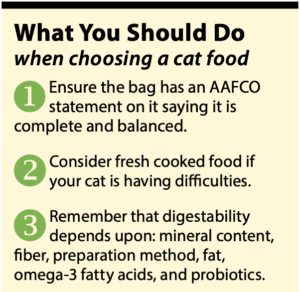 resolves on its own is nothing to worry about. Your cat likely ate something he shouldn’t have or is distressed about something.
Provided that your cat doesn’t have any other symptoms of illness, you can try managing his diarrhea at home. If he just has one episode of diarrhea, think over anything that he might have gotten into and cut out all treats and extra snacks for a day or two.
If your cat has more than one episode of diarrhea, consider starting a probiotic and/or feeding a bland, easily digestible diet for a couple days. This gives your cat’s gastrointestinal tract a break and makes its job easy while it is struggling. Plain cooked chicken and rice is a classic combination, or you can ask your veterinarian about a food designed to support the GI tract.
The best strategy is often to feed small, frequent meals. This gives the GI tract something small to work on without overwhelming it. After a couple days, you can transition your cat back to his normal food and feeding schedule. Make sure your cat always has water available.
Remember that diarrhea that lasts more than two days warrants veterinary intervention, and vomiting and diarrhea at the same time is an emergency.
What to Do: Recurrent Diarrhea
If your cat’s diarrhea doesn’t resolve with a bland, digestible diet and probiotics or if it keeps coming back, there may be something more going on. Many different health problems and infections can cause diarrhea, so you will need your veterinarian’s help to identify the underlying cause.
Diagnostics may include a fecal exam, bloodwork, and X-rays or ultrasound. Also bring as much information as you can about what has been happening with your cat: how often he has diarrhea, the volume of his stools, any changes in diet, any changes in your household, and any patterns or triggers that you have noticed. The history and diagnostic testing can help your veterinarian to narrow down the cause of the diarrhea.
Treatment can vary widely, but food is a critical tool in managing gastrointestinal disorders. It may take some trial and error to find the food that works best for your cat, so don’t be discouraged. Things your veterinarian may try are:
- Increasing the fiber
- Decreasing the fat content
- Hypoallergenic diets
An over-the-counter food may work, or your cat may need a prescription food to meet his needs.
Try to be patient. Chronic diarrhea is frustrating to be sure, and it can take weeks to months to find the solution that works for your cat. The gastrointestinal tract is complex, and inflammation from illness can cause lasting damage that takes a long time to resolve. The result will be well worth the effort.


