
Decoding pet food labels can be daunting, especially because there are so many foods out there. Let’s take a look at one of the words you might see on cat food labels: indoor.
What Is “Indoor” Cat Food?
“Indoor cat food” is a marketing term and does not guarantee anything about the food itself. That said, seeing “indoor” on a cat food label may suggest a few things about it.
“Usually, it’s lower in calories to help prevent obesity,” says Joseph J. Wakshlag, DVM, PhD, ACVN, ACVSMR, Professor, Clinical Nutrition and Sports Medicine and Rehabilitation at Cornell University’s College of Veterinary Medicine. “But of course, overfeeding any food will cause obesity.”
 Weight management is one of the challenges that indoor cats tend to struggle with because they tend to be less active than a cat who is actively roaming, hunting for food, and avoiding predators outside.
Other challenges common in indoor cats include hairballs, urinary tract issues, and improperly functioning immune systems. Pet food manufacturers look at these trends and often strive to design foods to address one or more of these specific issues.
Foods labeled for indoor cats are largely over-the-counter, which means that they have not undergone the same testing as prescription foods that are intended to treat and/or prevent health issues.
Also keep in mind that many of the descriptors on cat-food labels are either subjective or depend on context. This is especially true when looking for a low-calorie food to help with weight management.
“I would be more concerned about the calories on the bag than the marketing on the display panel,” says Dr. Wakshlag. “You could pick an indoor formula from one company that has more calories than another company’s regular food. The terms that mean something on the label of a cat food are ‘lite’ or ‘lean’ as those mean they are lower calorie than the company’s typical foods.”
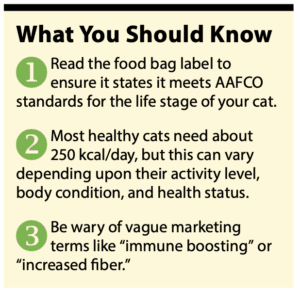
To be sure that a food is low calorie, check the label for the kcal per cup (dry food) or kcal per can (wet food). This is what tells you how nutrient dense a food is, and the info that you need to figure out how much of a food to give your cat.
Claims like “increased fiber” or “immune boosting” are vague terms that need to be put into context. Even if Food B has more fiber than Food A, it still might not be the amount of fiber that your cat needs.
Many different ingredients help to support a healthy immune system, so it is more helpful to look at which ingredients a food contains to determine whether they may translate into improved health for your cat.
Remember that your indoor cat does not have to eat indoor food. There are only two rules for choosing a cat food:
Your cat must like the food.
The food should be complete and balanced for your cat’s life stage, indicated by the AAFCO statement on the food bag or label.
As with any other marketing term or niche, indoor cat food has pros and cons that may or may not make it a good fit for your cat. The specific nutritional profile of each food matters more than whether it is marketed as being for indoor cats.
An indoor cat food may:
Be low calorie, or at least lower calorie than other foods
Include ingredients that prevent hairballs
Include ingredients that promote urinary health
Include ingredients that support skin and coat health
Include ingredients that support the immune system
You can use the term “indoor” to narrow down your food options, but it is still important to make sure the food you choose meets all of your cat’s needs. Other foods not labelled as indoor may also check these same boxes for you, or your cat might not require these features.
Bottom Line
Indoor cat food is a marketing term that indicates the food was designed to meet the needs of cats who live indoors, but the word “indoor” does not guarantee anything about the food’s ingredients or nutrient profiles.
An indoor cat food may be the perfect fit for your indoor cat, but it is not a requirement. It is also OK for an indoor-outdoor cat or a strictly outdoor cat to eat indoor cat food.
Choose the food that your cat likes and that meets his unique needs, as long as it is complete and balanced.


