
One of the most important parts of your cat’s dental care is routine examinations. By 3 years of age, many cats have some visible dental disease. Catching these problems early means better resolution.
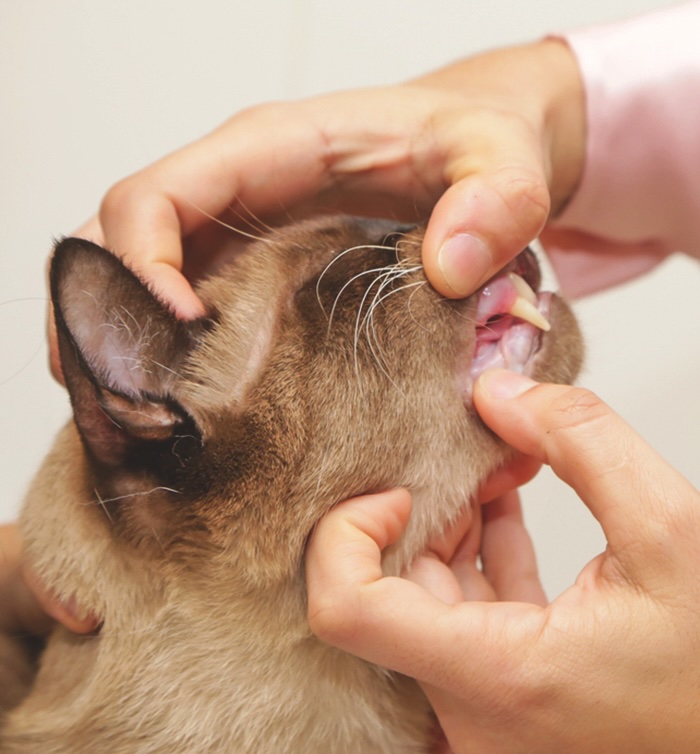
If you have a cooperative cat, you can do a quick oral exam at home. Lift her lips and look for plaque (a hard yellow/brown crust) on her teeth. Some cats might even let you open their mouths and look inside, but most cats don’t like any manipulation of their mouths, unless you have been a dedicated tooth brusher.
Your quick look, even with a cooperative cat, won’t tell you about most of the periodontal disease and resorbed root problems that abound in our feline friends.
Note: That yellow, hard tartar develops from plaque (a colorless film) on the cat’s teeth. You really can’t see plaque, but brushing your cat’s teeth will remove it. By removing plaque, you can prevent tartar.
The Veterinary Check
A young cat with no obvious signs of a dental problem who is eating and chewing normally, without excess drool, etc., may be able to pass muster with a careful look by your veterinarian during her annual physical. If there is any question, however, sedation or even general anesthesia may be required to truly evaluate dental health.
On young-cat exams, your veterinarian will be looking for any problems such as retained deciduous (baby) teeth, an abnormal bite, and any missing teeth. These conditions are somewhat unusual in cats but can lead to eating problems down the line.
Dental X-rays show problems like resorbed tooth roots that aren’t evident on a visual oral exam. They require awkward manipulation of the mouth and aren’t possible on even the most cooperative awake cat. Your veterinarian will also use a dental probe to check for periodontal disease, which may be limited to regions under the gum line.
Periodontal Disease
If your cat does need dental X-rays, possibly as a prelude to a thorough cleaning under anesthesia, a pre-op physical exam and some basic bloodwork will usually be done. The two most common feline dental problems are periodontal disease and tooth resorption.
Periodontal disease is the most common. About 85% of cats over 6 years old have some degree of this condition. They accumulate plaque and tartar on the surface of their teeth with associated gingivitis or inflammation of the gums. Mild cases may be managed with a thorough cleaning and follow-up dedicated dental care by their owners, but if this progresses, numerous teeth may need to be extracted.
About 50% of cats will develop tooth resorption, where the tooth is slowly broken down by the body. The plaque is built up in the dentin layer of the teeth, below the enamel.
The immune system becomes involved and eventually the affected teeth and their roots are permanently damaged. If the damage goes into the pulp of the teeth, this can be extremely painful. To restore comfort, any teeth that are being resorbed should be extracted. We don’t fully understand why tooth resorption occurs.
Any broken teeth, most commonly the canines, provide a pathway for bacteria to enter the tooth and get into the sensitive pulp. This causes a painful infection and often destroys the tooth root. Extraction is the most likely treatment recommendation in these cases.
Gingivitis
Feline gingivitis/stomatitis is less common but can be severe. This problem usually involves an upset in the immune system, so cats with feline leukemia virus (FELV) or feline immunodeficiency virus (FIV) have a greater risk.
Gingivitis is the early, mild form of the disease, with stomatitis (inflammaion of the cheeks,lips, tongue and/or palate) being the dramatic end game. Stomatitis causes bloody drool, horrendous breath, and a lack of appetite due to pain. Very mild cases may be managed medically with periodic antibiotics and daily dental care such as dedicated toothbrushing, but these are few and far between.
Most cats with stomatitis face removal of most of their teeth to provide relief from this painful condition. Surprisingly, once their mouths heal, these cats can usually eat normally (even kibble) and go on to have normal lives.


