
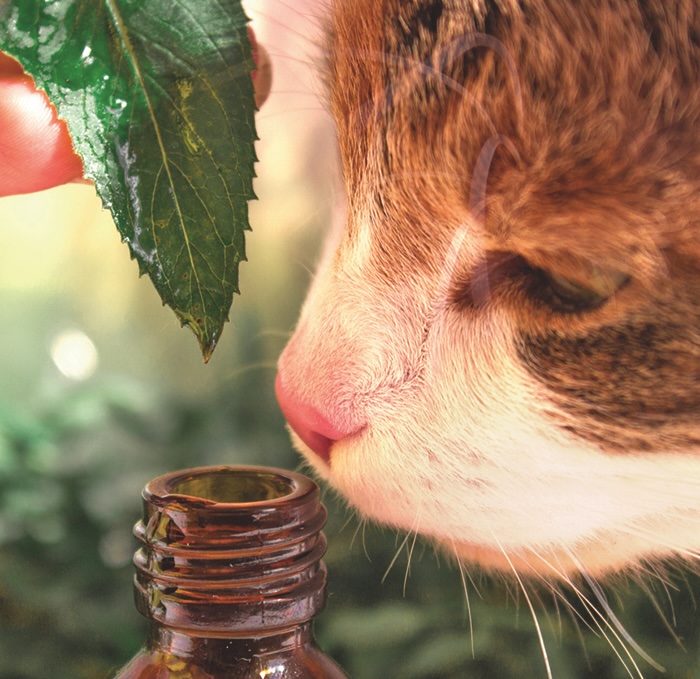
By now, if you are on social media or the internet at all, you’ve probably heard about the dangers of essential oils for cats. While it is true that essential oils can be toxic to cats, some may be safe around cats when used carefully and in small amounts.
What Are Essential Oils?
Essential oils are powerful, concentrated compounds extracted from plants. Some have antimicrobial properties, and they are commonly used in insecticides, insect repellants, perfumes, cosmetics, food flavorings, preservatives, and medications. They are also used in aromatherapy to promote human wellness.
Because they are so concentrated and volatile (evaporate rapidly), essential oils must be used correctly and with caution for both you and your cats. They should be chosen with care, as there is little-to-no governmental regulation of their production and sale, and commercial products vary widely in quality and purity. Some are even synthetic. Generally, the less pure a natural essential oil is, the less expensive it is and the higher the likelihood it contains harmful volatile organic compounds (VOCs) like toluene, acetylaldehyde, ethanol, and acetone.
Why Are Cats So Susceptible?
One of the reasons essential oils are especially problematic for cats is that they don’t have much of an enzyme called glucuronyl transferase, which is necessary for breaking down the essential oil compounds so they can be eliminated from the body, mainly through the feces and urine. This means they are subjected to the systemic effects of these compounds for longer periods of time after exposure.
Essential oils can get into a cat topically (absorbed through the skin), orally (ingested), or by inhalation. Once in the cat, they are usually rapidly delivered to muscles, fat stores, and nerve tissue. The skin, gastrointestinal tract, liver, kidneys, and central nervous system can all potentially be affected by absorption of essential oils.
Signs of Toxicity
Signs of essential oil toxicity vary depending on the specific oil and the degree of exposure but include things like sores/ulcers in the mouth, drooling, vomiting, diarrhea, increased respiratory rate, trouble breathing, cyanosis (mucous membranes turning blue), seizures, signs of shock, weakness, lethargy, incoordination, muscle tremors, collapse, and coma.
With topical exposure, there may be intense itching, hair loss, redness, and even ulcerated wounds, as undiluted essential oils can burn the skin.
If Your Cat Is Exposed
If you have essential oils in the house and you suspect your cat may have contacted them, go to your veterinary hospital right away. Bring whatever your cat may have been exposed to with you.
When your veterinarian examines your cat, in addition to the signs mentioned above, they may find that your cat’s temperature and/or blood pressure is either very high or very low. If the liver is affected, your cat may be jaundiced (yellow mucous membranes), and pulse oximetry (measures oxygen levels in the bloodstream) may show decreased oxygen levels.
Bloodwork may show elevations of kidney and liver values. There are specialized tests (gas/liquid chromatography, mass spectrometry) to confirm an essential oil is the cause of your cat’s illness, but these are expensive and must be sent to an outside laboratory, which takes too much time. Treatment based on history, clinical signs, and suspicion begins right away.
No Antidote
There is usually no antidote for essential oil toxicity. Inducing vomiting is NOT a good idea when dealing with volatile compounds, as the risk of aspiration pneumonia is too high. This means that treatment usually involves supportive care and treating issues as they arise:
- Shock is treated with intravenous fluids.
- Kidneys may be protected with intravenous fluid therapy.
- Seizures are treated with anticonvulsants.
- Topical contact is treated with bathing to remove any residual oil.
- The GI tract may be treated with antiemetics and gastroprotectants.
- Body temperature will be monitored and managed (heating or cooling as needed).
- Muscle relaxers can help relieve muscle tremors, and pain management is a must.
- Kidney and liver values will typically be monitored for several days after exposure.
Just Take Precautions
Essential oils can be dangerous for your cat. The worst-case scenario is probably your concentrated essential oil accidentally spilling somewhere and your cat walking through it and ingesting it while grooming. Pet-proof the area where you keep your essential oils so this can’t happen.
If you use a diffuser, do not use it anywhere near where your cat spends time. The aerosolized droplets can accumulate on your cat’s fur, and the cat can ingest too much of it when grooming.
If you have a cat with respiratory issues (e.g., asthma), it would be best to avoid using an essential oil diffuser anywhere in your home. You should also avoid the use of scented candles, air fresheners, or aerosols (hairspray, deodorant) as best you can if you have an asthmatic kitty.
If essential oils are important to you, work to ensure your cat’s safety. You can use them, but they must be handled with knowledge, respect, and extreme care—for both you and your cat.
Yaraslau Butkevich | iStock
The essential oil dripping from this basil leaf is toxic to cats.


