
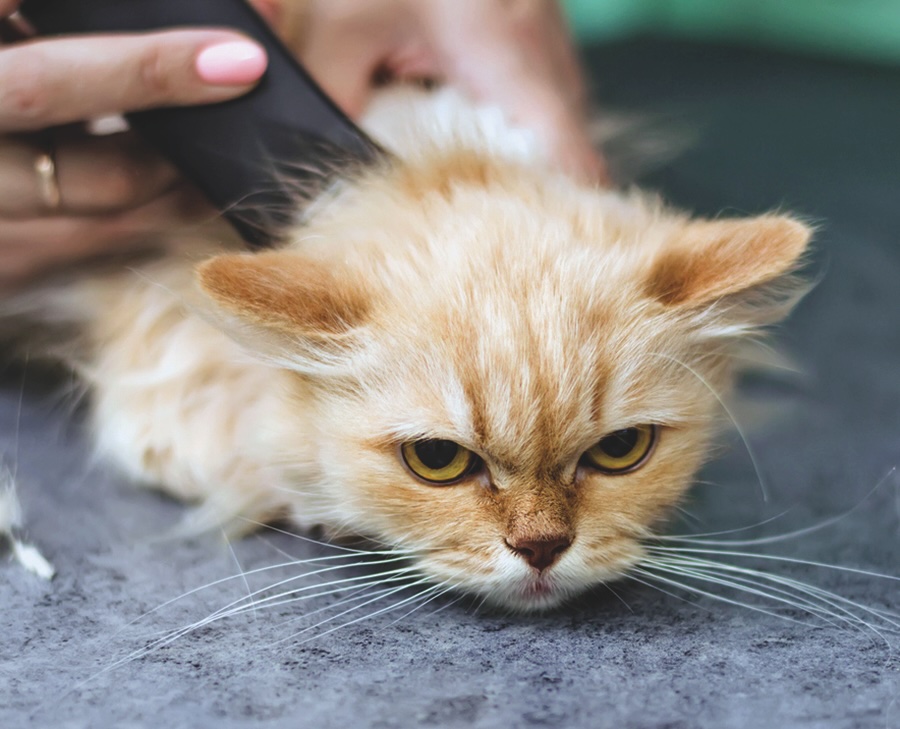
Longhaired cats—especially those with soft, cottony coats—are the most prone to mats and tangles, but any cat can develop mats. Shorthaired cats can get mats if they are not grooming themselves due to illness or obesity. Whatever the cause, once your cat has a mat, she will need your help to remove it.
Mats Are a Problem
Matted hair forms dense clumps that often grow larger over time as more hair adheres to the mat. The tangling hair can tug on the skin, which is uncomfortable for your cat.
Worse still, that thick layer of tangled fur traps moisture against the skin, creating the perfect environment for bacterial and fungal infections. Over time open sores can develop. If the mat is located near your cat’s genitalia, urine and feces can get stuck in the mat, irritating the skin and promoting infections.
Proper Tools
Your goal is to remove mats without damaging your cat’s skin. Feline skin can be delicate, especially if it is compromised due to injury or infection. The best tool for the job will depend on the mat size, how close it is to the skin, and how cooperative your cat is.
Corn Starch or Detangling Spray
A pet-safe detangling spray can help loosen the hairs at the edge of a mat or knot. For small tangles, you may be able to gently tease the hairs apart after applying a detangling spray. For larger mats, the spray can still make removal go a bit more smoothly.
No detangling spray on hand? Try rubbing a little cornstarch into the mat.
Dematting Tool or Brush
A dematting tool or dematting brush is designed to break up mats and tangles. They usually work best on smaller or looser mats. These tools are available at most pet supply stores or online in a variety of sizes and colors.
Blunt-Ended Scissors
Use scissors with caution, as it is very easy to cut skin. A small pair of grooming shears with blunt, rounded ends is the safest to use with cats so that you don’t have to worry about poking your cat with sharp tips. Scissors should only be used on mats that you can lift away from the skin and, preferably, insert a comb between the end of the mat and the scissors so you don’t cut the skin.
If you can’t use the comb, lift the mat so that you can grip the free hairs beneath the mat between your fingers. Your fingers act as a protective barrier between the scissor blades and your cat’s skin. Lay the scissors on their side atop your fingers and cut the mat free.
For slightly tighter mats, you can slide one blade of the scissors underneath the mat so that the blunt edge is against the skin and the cutting edge is aimed away from the skin. Cutting in this way won’t completely remove the mat, but it can break up the mat into smaller pieces that are easier to handle.
Electric Clippers
Clippers are the MVPs of removing mats. A shave is often the only way to remove mats that are tight to the skin and is the quickest solution if your cat has a lot of mats.
You can purchase clippers to use at home. Choose quiet clippers that will be less scary for your cat and start by letting her get used to the sound. Shave in the direction of the hair as much as possible, but sometimes it may be necessary to go against the grain. Work in small sections and gently pull the skin out flat to reduce the risk of little cuts and scrapes from the clipper blades.
Groomers can do a partial or full-body shave on friendly, well-behaved cats. For our more fractious felines, it may be necessary to pursue a sedated shave at your veterinary facility. Sedation is also a good idea if your cat seems painful or does not like to be handled, especially if some of her mats are on her belly or in her armpits.
 Preventing Mats
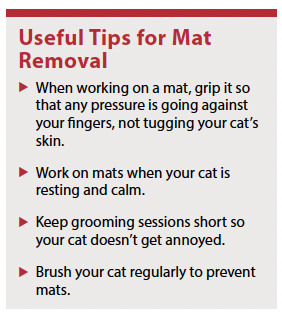
Once your cat is mat-free, plan to prevent this from happening again. For chunky kitties, work with your veterinarian to design a gradual weight-loss plan. And for all cats prone to matting, build regular brushing into your routine.
Slicker brushes are popular with many cats because they feel like a cat’s rough tongue. Longhaired cats may prefer a pin brush with longer tines.
Start slowly with brushing by just doing one or two swipes on your cat’s back. Reward with petting, play, or treats. Some cats enjoy being brushed while they eat. Gradually build up to longer brushing sessions and to brushing problem areas such as her underside and armpits. Short, frequent sessions are usually tolerated better than brushing your entire cat in one go.
You can also do a hygienic clip and shave the hair around the anus and genitalia to prevent matting and buildup of waste in that area.


