Cats are curious by nature, and they love to investigate objects with different shapes and textures. This includes picking things up, tasting them, tossing them around, and sometimes accidentally swallowing them. Some favorite foreign objects that make their way into the stomachs of cats include hair ties, rubber bands, tiny toys, buttons, coins, ear plugs, button-cell batteries, jewelry, small bones, tinsel, ribbon, string, thread, yarn, and dental floss. Linear objects like string, thread, yarn, and dental floss are especially dangerous in cats.
“Due to the cat’s unique tongue anatomy (little backward pointing projections), if they ingest string or ribbon they tend to swallow it, not spit it out,” says Jan MacDonald, DVM, DACVS, graduate of the Cornell College of Veterinary Medicine and board-certified veterinary surgeon. “If the object becomes tethered at some position, like under the tongue, the swallowed end will cause the intestines to bunch up with normal gut movements. This can lead to severe injury to the intestines, even rupture.”
If you’ve seen your cat playing with string and he starts showing any of these signs, get to the vet right away. Your veterinarian will do a thorough oral exam, checking underneath the tongue for string that may have looped around the base of the tongue. Degree of pain is assessed by abdominal palpation, which may also reveal abnormally bunched or firm intestines.
Abdominal X-rays and/or ultrasound are used to diagnose intestinal blockage. In the case of string foreign bodies, the actual blockage is caused by bunching up of the intestines, which “accordion up” on themselves and are held tightly together by the string. This causes not only a blockage, but also severe damage to the lining of the intestines and potential blockage of blood supply. “The string can actually saw (or abrade) its way through the intestinal wall, causing leakage of intestinal contents into the abdomen,” says Dr. MacDonald. “This can lead to life-threatening peritonitis or death.”
Treatment
The treatment of linear foreign bodies almost always requires aggressive supportive care with intravenous fluids, antibiotics, and emergency surgery. The surgery can be extensive. “Often the surgeon needs to make multiple small incisions in the cat’s stomach and intestines to gently relieve the bunching and remove the object without causing further damage to the intestines,” says Dr. MacDonald.
It is not unusual for there to be more than a dozen incisions made throughout the intestines, with small lengths of the string removed one at a time. This results in a lengthy and expensive procedure. And the road to recovery can be a bit rocky. Infection is a potential post-operative complication, and pain, despite best efforts to control it, can lead to anorexia (complete loss of appetite), which in and of itself can become life-threatening.
Post-operative anorexia sometimes necessitates placement of a feeding tube. Either way, your cat will likely spend several days in the hospital after surgery, with careful monitoring, intravenous fluids, pain medications, and antibiotic therapy before being sent home.
Why not just cut the string if you can see it looped around the tongue? Or what if you see string sticking out of your cat’s anus? Why not just pull it out? If your cat is showing any of the above listed signs, it means there is already a bunching of intestines and likely intestinal obstruction.
“Simply cutting the string may not solve the intestinal bunching,” says Dr. MacDonald. “Pulling on a string protruding from the anus in a cat with signs of intestinal blockage is likely to cause further damage to the intestines.” There’s usually no way out of this other than emergency surgery.
If your cat has been vomiting and X-rays reveal a foreign object in the stomach, there are potentially two ways to get it out. Surgery is one option and may be the only option depending on the type and location of the foreign body.
The other option, depending on the nature of the foreign body, is endoscopic retrieval (removal using a flexible camera that is passed through the mouth into the GI tract). The foreign body must be small enough to safely pull up and out through the cat’s esophagus, and it cannot have sharp or jagged edges. Obviously, endoscopic foreign body retrieval is much less invasive than abdominal surgery, with less post-procedure pain, less risk of infection, and less recovery time. Unfortunately, it is not always viable.
You Can’t Wait and See
Waiting to see if the object will pass is not a great option in cats, as their intestines are generally much smaller in diameter than dogs’ and there is risk of intestinal blockage. Inducing vomiting is also not a great option in cats for a multitude of reasons described below.
There is an area in the brain called the chemoreceptor trigger zone (CTZ) that is basically the command center for vomiting. Antiemetics (medications prescribed to stop vomiting) work on receptors in this area of the brain. Emetics (substances used to induce vomiting) also work in the brain’s CTZ. Receptors in the CTZ in cats are way less receptive to stimulation by emetics than those of dogs, meaning that emetics may not work well in cats.
Cats also tend to have untoward side effects (e.g., extreme agitation) to some of the emetics commonly used in dogs. Additionally, using hydrogen peroxide as an emetic in cats is an absolute no-no, as it can cause severe damage to the esophagus and stomach. So, the options to induce vomiting in cats are not only limited, they are not guaranteed to successfully induce vomiting. The available options are all sedative drugs (dexmedetomidine, xylazine, hydromorphone) that cause vomiting as a side effect. Inducing vomiting in a sedated animal puts that animal at risk for aspiration pneumonia or choking. So, don’t be surprised if your veterinarian does not suggest inducing vomiting.
Just be aware that your cat may ingest things he shouldn’t, whether it be accidental or intentional, potentially resulting in an urgent medical situation. Keep anything remotely linear in nature out of your cat’s reach, as these string-like items are favored fun for cats and are especially dangerous. And remember, vomiting in a cat is usually worthy of an X-ray, especially if it’s protracted.
Signs of an Ingested Foreign Object
- Vomiting
- Abdominal Pain
- Lethargy
- Gagging
- Hiding
- Loss of Appetite
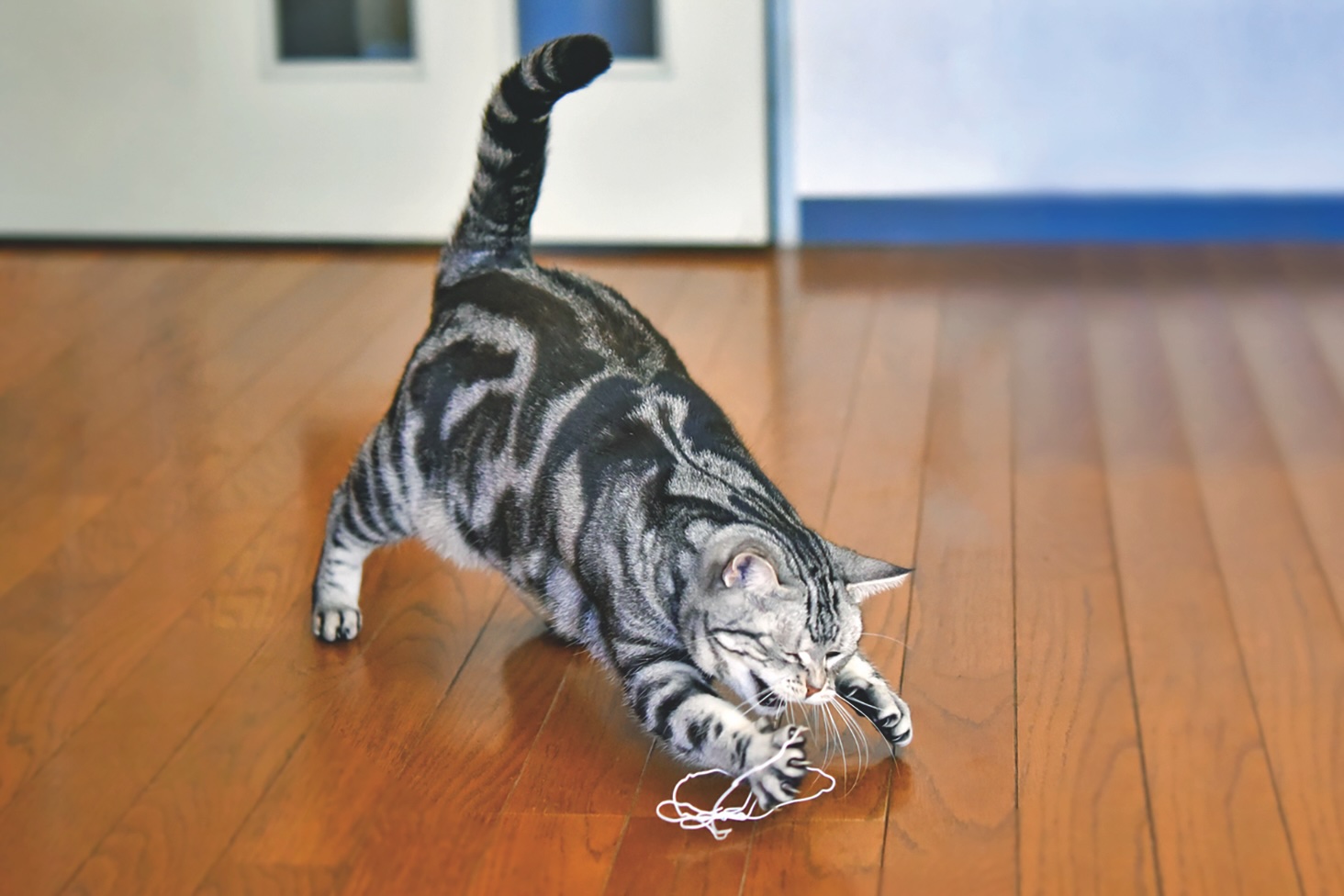
- FeverIt’s all fun and games until Fluffy needs surgery! Watch your cat when he’s playing to ensure he doesn’t swallow the “toy.”
“Pulling on a string protruding from the anus in a cat with signs of intestinal blockage is likely to cause further damage to the intestines,” says Dr. Jan MacDonald.