
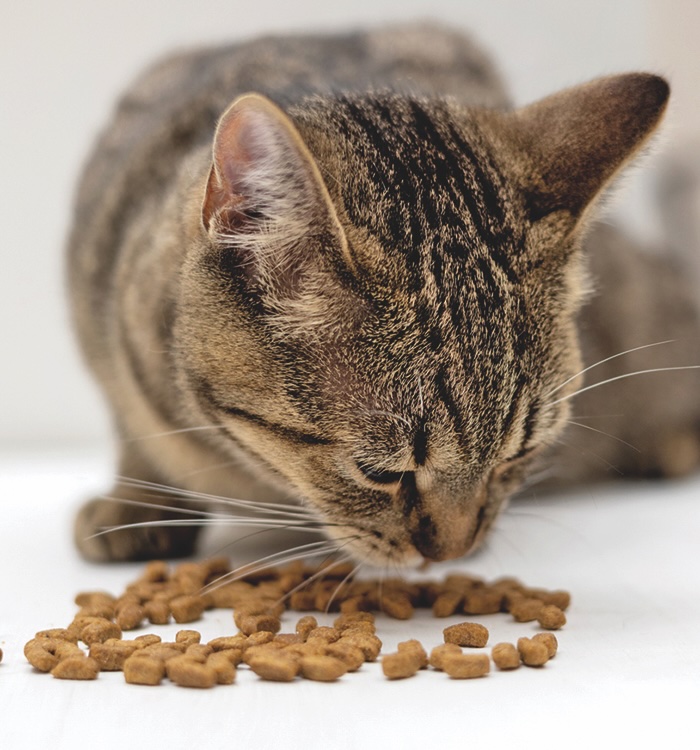
Q: My approximately 7-year-old cat, who we acquired from a very sad hoarding case, was recently diagnosed with the beginnings of chronic kidney disease.
While he was in the shelter prior to our taking him in, he was fed almost any brand of dry food, whatever was donated or purchased by the city. In order to give his stomach a rest, I started purchasing a commercial chicken and rice adult cat food. He’s been eating it for four years).
Our veterinarian determined that he was showing signs of kidney problems and recommended that he start eating a prescription wet-food kidney diet now.
He is a bit finicky about what he eats, and we have tried a couple of different flavors of prescription wet food, but he will eat the liquid first and sort of push the rest around without finishing it.
I do not think he’ll eat a wet-food only diet, and I feel that he will have to have his dry food also despite the fact that it may not be as good for his hydration status.
He has a water fountain, and I clean it every two weeks so he has a constant supply of clean flowing water.
I haven’t done anything about his dry diet yet, but I want him to be on one diet consistently.
Can you provide some advice?
A: Thanks for getting in touch, and for taking this lucky boy into your home.
As I am sure you know, chronic kidney disease (CKD) is very common cats, affecting up to 25% of cats in the 4- to 10-year-old range and as high as 80% of geriatric cats.
I understand your concern in making sure he is eating the right food for his condition, and perhaps a brief review of nutritional considerations in cats with kidney disease would be helpful.
Given the fact that the only intervention that has been shown to significantly modify outcomes in cats with CKD is dietary modification, what we feed cats diagnosed with CKD is clearly important. The major dietary considerations for optimal feeding of cats with CKD are restriction of protein and phosphorus, with additional consideration for antioxidant and B vitamin supplementation.
Regarding the issue of dry versus wet food, it is true that wet food contains more water, and since maintaining good hydration is crucial for cats with CKD, wet food is a good choice as long as cats will eat it.
Since cats can be finicky, especially when their food is being changed, and knowing that if they don’t eat for as short a period of time as two days they can experience a potentially serious condition called hepatic lipidosis, though, it would be better to feed a cat with CKD an appropriate kidney-friendly dry diet that they will eat than to try to force them to eat wet food.
I can see that you are doing a good job of making sure that there is always enough fresh water available (again, an important consideration for cats with CKD), and you can also add water to dry food to supplement water intake.
There are several high-quality dry prescription kidney diets that fulfill the optimal dietary requirements for cats with CKD, and you can talk to your veterinarian about which might be best for your kitty.
Importantly, I am not aware of any over-the-counter (i.e., that you can find in the supermarket for example) cat foods that meet the dietary requirements for cats with CKD.
It is possible to formulate a kidney-friendly diet for cats at home, but this should only be done in consultation with a veterinary nutritionist.
For your kitty, I agree that if he won’t eat the wet food, the better choice is to find a prescription veterinarian-recommended dry food that your cat will willingly eat.
I hope this is helpful, and please send an update when you can.


