
A cat struggling with anxiety or aggression is not fun. Calming chews and similar products are an easy thing to try, but quality matters, and expect that even a high-quality product will be part of a larger management plan.
“A few ingredients have modest controlled evidence and are reasonable adjuncts for mild, situational stress, but they don’t replace diagnosis, behavior modification, or medication when indicated,” says Sun A. Kim, PhD, DVM, DACVB, Duffield Assistant Professor in the Department of Clinical Sciences at Cornell University’s College of Veterinary Medicine.
Limited Research
There’s no easy way around it: Studying the effects of food and supplements on behavior is hard. Many different factors impact your cat’s behavior, including his genetics, his life experiences, his health, and his current environment.
Cats do not live in a vacuum, so it can be difficult to determine whether a change in behavior is due to a new food item, a change in routine, a change in the home environment, or to just having a really good or bad day.
Researchers must consider all these factors and control for confounding influences during studies focused on figuring out whether a new calming chew is helping a cat or not.
Formal research studies are also very expensive. This financial barrier, along with these other considerations, often results in cats not getting a large piece of the research funding pie.
Because of all these challenges, we are still in the early stages of understanding how various ingredients can help to calm our cats. As time goes on, additional studies will likely reveal that some of the products we thought were helpful are not and that new ones do benefit our feline friends.
 Does My Cat Need a Calming Supplement?
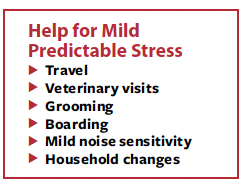
“Calming supplements are best for mild, situational, or predictable stress, such as travel, vet visits, grooming, boarding, mild noise sensitivity, or household changes,” says Dr. Kim. “They are always an adjunct to behavior modification, never a substitute.”
Like so many things, mild stress, anxiety, and aggression still benefit from a multi-modal treatment plan that targets the issue from multiple angles. Calming chews, tablets, and probiotics can help to make other management strategies more effective. “Rule out medical and pain-related contributors first,” says Dr. Kim.
Once your veterinarian has given your cat a clean bill of health, you can add a calming supplement and make a training or management plan tailored to his specific challenges. For the cat who doesn’t like to travel, teach him to get in and out of his carrier as a trick. Practice at least once a week so that his carrier is part of his normal routine and not a scary thing that he only sees occasionally. For the cat who doesn’t like veterinary exams, practice basic handling at home. Start by just running your hands over his body once before meals or playtime, then build to touching each of his paws and his ears over time.
Remember that changing behavior takes time. “The effects of daily-use products (probiotics, alpha-casozepine, tryptophan diets) often builds over two to six weeks, while L-theanine is given situationally,” says Dr. Kim. Behavioral modification and training should progress slowly so that initial steps are easy for your cat, and you can build his confidence and comfort over time.
Scheduled events such as moving or boarding your cat while you go on vacation allow you to plan. Start a calming diet or supplement far enough in advance that it will be effective when it needs to be.
When to Skip Calming Chews
“Calming chews are not appropriate as sole treatment for moderate-to-severe anxiety or separation-related disorders,” says Dr. Kim. “Those need a veterinary or behaviorist workup, often with medication.” Calming products work too slowly and are generally too mild to manage severe behavioral issues.
Certain calming supplements may also be inappropriate for your cat if he is allergic to one or more of their ingredients.
Check Ingredients
An attractive label with a catchy name does not mean that the product will work. Instead, look for active ingredients that have some proof of efficacy.
The most promising calming ingredients for cats right now are:
- Alpha-casozepine
- L-theanine
- L-tryptophan
- Bifidobacterium longum BL999
- Alpha-Casozepine
This is a milk-derived protein that was evaluated in a randomized, blinded, and placebo-controlled study. “Alpha-casozepine has the strongest feline data, with . . . improvement in fear of strangers and contact tolerance,” says Dr. Kim. “A later vet-visit study found preliminary benefit on autonomic measures, though not on fecal cortisol.”
Zylkene is a product for cats that utilizes alpha-casozepine. Zylkene comes in capsules that you can give to your cat whole or open to sprinkle the powder onto food. It needs to be given for several days in a row to see effects, so it is best to start giving it several days before a known stressful event, such as a veterinary visit, or to give it daily long-term for general anxiety.
L-Theanine
This is an amino acid derived from green tea that reduced subjective signs of stress in cats in an open-label field study. Dr. Kim says it is “promising, but uncontrolled.”
Anxitane is a product for cats that utilizes l-theanine. It is a chicken-flavored chewable tablet that can be given on a regular basis or used situationally when your cat is stressed.
L-Tryptophan
This is a serotonin and melatonin precursor that can be given by itself but has mainly been studied in combination diets such as Royal Canin Calm, which also includes alpha-casozepine. “It reduced anxiety in an unfamiliar setting, but not fear of strangers,” says Dr. Kim. “Brain uptake is limited by competition with other amino acids.”
Royal Canin Calm is a dry cat food that should be fed on a regular basis to provide calming effects. It is recommended to start feeding it at least 10 days before a known stressful event that may upset your cat.
Bifidobacterium Longum (BL999)
This probiotic was evaluated in a 12-week placebo-controlled study that has not been published as a peer-reviewed paper at this time. “The supplemented group had fewer cortisol abnormalities, less sneezing and pacing, and more social contact,” says Dr. Kim.
Purina Pro Plan Calming Care is a product for cats that utilizes BL999. It is a flavored powder that can be sprinkled on your cat’s food daily. It can take six weeks to see calming effects, so it should be given daily long-term for general anxiety.
Choosing a Product
You know which ingredients are most likely to benefit your cat, but how do you choose a product?
“Pet supplements aren’t FDA pre-approved for efficacy, and ‘natural’ or ‘vet-formulated’ mean nothing on their own,” says Dr. Kim.
Look for:
- National Animal Supplement Council (NASC) Quality Seal
- Transparent labeling
- Evidence for the actual product, not just the ingredient
- A reputable source, meaning the manufacturer, a vet clinic, or an authorized retailer
 Labels should give the milligram (mg) concentration for active ingredients rather than a generic proprietary blend. This is important because the lack of regulation in the supplement market means that a product can still list an ingredient even if only a tiny amount of it is present. Unless you know how much of the ingredient is present, you cannot know if it will be a therapeutic dose capable of helping your cat.
Product manufacturers should have or be able to provide results of studies showing proof of efficacy for their product. Processing can change how an ingredient functions in the body, so two products that contain the same active ingredient might have varying effects for your cat.
Another unfortunate fact of the supplement market is the many fake and counterfeit products out there, especially online. If a product’s price seems too good to be true, it probably is.
Feeling overwhelmed? Ask your veterinarian which product(s) she recommends for your cat and where you can purchase it.


