
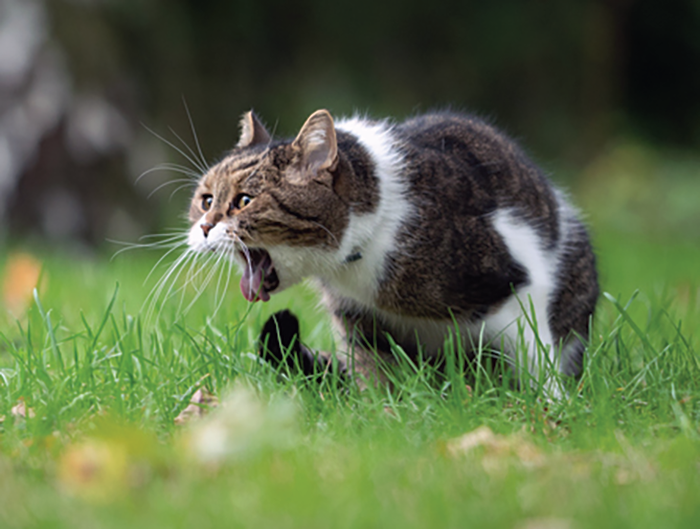
Some folks think cats and hairballs just go together like Tiger Woods and golf, or Michael Jordan and basketball, or Taylor Swift and Travis Kelce. We are used to the strong association between these things. Can’t have one without the other, right? Not so fast. Just because you’re a cat doesn’t mean you should vomit up hairballs.
“I often hear from clients when getting a history and asking about vomiting, that their cat vomits a ‘normal’ amount and that it isn’t concerning,” says Patrick Carney, PhD, DVM, ACVIM, Associate Professor, Section of Community Practice Service, Cornell University College of Veterinary Medicine. “The fact of the matter is there is no amount of vomiting that is ‘normal’ for cats, and chronic vomiting is a sign of illness.”
Hairballs Matter
If it’s always a hairball your cat vomits up, this does not create a free pass. Hairball vomiting is not normal in cats. At the very least, it implies decreased gastrointestinal motility, whether it be from primary gastrointestinal disease or secondary to another disorder.
If your cat vomits anything on a regular basis, it’s time to get to the bottom of it. The first step is to determine whether your cat is vomiting or regurgitating. There is an important difference.
“Vomiting is an active process and requires contraction of the abdominal muscles and opening of muscular sphincters in the stomach and esophagus to forcefully expel contents from the stomach or small intestine,” says Dr. Carney. “There is usually some lead up to vomiting: abdominal contractions, audible retching, signs of nausea (drooling, lip licking). The contents of vomit can vary: clear fluid, yellow fluid, food in various stages of digestion, foam, or some combination.”
Regurgitation is different. “Regurgitation is a more passive process of expelling contents from the esophagus before they get to the stomach and can be a more benign process,” says Dr. Carney. “A common cause for regurgitation is eating very quickly such that the food bolus is very large. Regurgitation often happens right after eating without any lead up. The content of regurgitation is usually undigested food (often whole if not chewed) and it is tubular (the shape of the esophagus); some animals will try to eat it again after it comes up.”
Why Is Your Cat Vomiting?
Now that we have determined your cat is actually vomiting, not regurgitating, we need to figure out why. The cause of vomiting usually falls into one of two broad categories:
Gastrointestinal disease
Non-gastrointestinal disease
The diagnostic workup to get this figured out typically starts with a careful history regarding what’s been going on at home (including the length of time and frequency of vomiting, dietary history, any stressful changes at home, etc.) and a thorough physical examination.
From there, diagnostics typically include varying combinations of:
Bloodwork, including a chemistry screen, complete blood count (CBC), thyroid test for cats over 5 years of age, FeLV/FIV testing for young and previously untested cats, fasted gastrointestinal panel (cobalamin, folate, fPLI, TLI), heartworm antigen testing (vomiting is a common symptom seen in cats with heartworm disease)
- Urinalysis
- Fecal test for parasites
- Chest and abdomen X-rays
- Abdominal ultrasound
- Gastrointestinal biopsiesFinding the CauseYour veterinarian will have an index of suspicion for what may be going on with your cat after the initial history and physical examination. This information will drive the direction the diagnostic process takes.“In younger-middle aged cats, vomiting tends to be primarily gastrointestinal, with common causes being gastrointestinal obstruction, non-obstructive acute gastroenteritis (for example, from a smaller foreign body that is passing or dietary indiscretion), acute pancreatitis, and chronic enteropathy (often inflammatory enteritis, but rarely intestinal small cell lymphoma),” says Dr. Carney. There is a syndrome of triaditis in cats that is characterized by intestinal, pancreatic, and hepatobiliary (liver and gall bladder) inflammation, with intestinal inflammation being the primary driver. “In middle-age to older cats, we start to see more non-gastrointestinal causes of vomiting emerge; the most common would be chronic kidney disease and hyperthyroidism,” says Dr. Carney.
“Older cats are less likely to eat things they shouldn’t, so we don’t tend to see as many obstructive or acute gastroenteritis cases, but pancreatitis does still occur (either alone or associated with triaditis). This is also the time when we diagnose chronic enteropathy and there is a higher likelihood of intestinal small cell lymphoma. We also start to see an increase in other forms of gastrointestinal cancer (large cell lymphoma, mast cell tumor, intestinal carcinoma) as well as cancer outside the GI tract.”
Vomiting Is Not Normal
The big thing to remember is that vomiting is not normal in cats, and it is important to get to the bottom of it. Many approaches to resolving vomiting in cats depend on cause, including:
- Surgical intervention for obstructive disease
- Diet trials for food allergy or intolerance
- Husbandry changes for cats who eat too fast
- Broad-spectrum deworming if indicated
- Medical therapy for any underlying non-gastrointestinal disease
- Supportive care including antiemetics, gastric acid reducers, and prokinetic medications
A discussion with your veterinarian may provide an effective treatment.
“In middle-age to older cats, we start to see more non-gastrointestinal causes of vomiting emerge; the most common would be chronic kidney disease and hyperthyroidism,” says Dr. Patrick Carney, PhD, DVM.


