
Glaucoma is a painful disease that can result in blindness. It happens when something goes wrong with the normal movement of fluid through the eyeball, resulting in elevated intraocular pressure (IOP). This increased pressure damages components of the eye that are essential for vision.
“The most common sign of glaucoma in cats is a large, wide-open pupil in the affected eye,” says Noah Plotsker, DVM, Comparative Ophthalmology Resident at Cornell’s College of Veterinary Medicine. “Other signs include redness in the white part of the eye, a cloudy or bluish look to the front of the eye, and pain. Cats with eye pain may squint, have watery eyes, or hide more than usual.”
As the disease progresses, vision loss, bulging eyeball (bupthalmos), lens luxation (when the lens moves out of its normal location), and a cataract may occur.
Two Types of Glaucoma
The fluid inside the eye is called the aqueous humor. It provides nutrition to structures within the eye and aids in waste removal.
Aqueous humor is continuously produced by the ciliary body in the eye and continuously drains out through what’s called the iridocorneal angle. Any disruption of this drainage can result in glaucoma.
“Cats can have two types of glaucoma: primary or secondary,” says Dr. Plotsker. “Primary glaucoma is caused by genes passed down from the parents. These genes cause problems with how fluid drains from the eye. Secondary glaucoma happens because of other eye problems, such as long-lasting inflammation, eye tumors, or when the lens moves out of place. Secondary glaucoma is more common in cats.”
Primary glaucoma, while rare, has been documented in Siamese, European Shorthair, Russian Blue, Burmese, and domestic shorthairs. While it usually starts with one eye, both eyes are eventually affected. Anterior uveitis (inflammation of the uvea, the pigmented part of the eye that contains many blood vessels) is the most common cause of secondary glaucoma in cats. This usually affects only one eye but can happen in both.
Anterior uveitis can occur due to trauma, tumors, and inflammation in the eye itself, or as an ocular manifestation of systemic disease (OMSD). The list of potential causes of OMSD is long, so if your cat is diagnosed with secondary glaucoma due to anterior uveitis, expect a medical work up to rule out systemic disease.
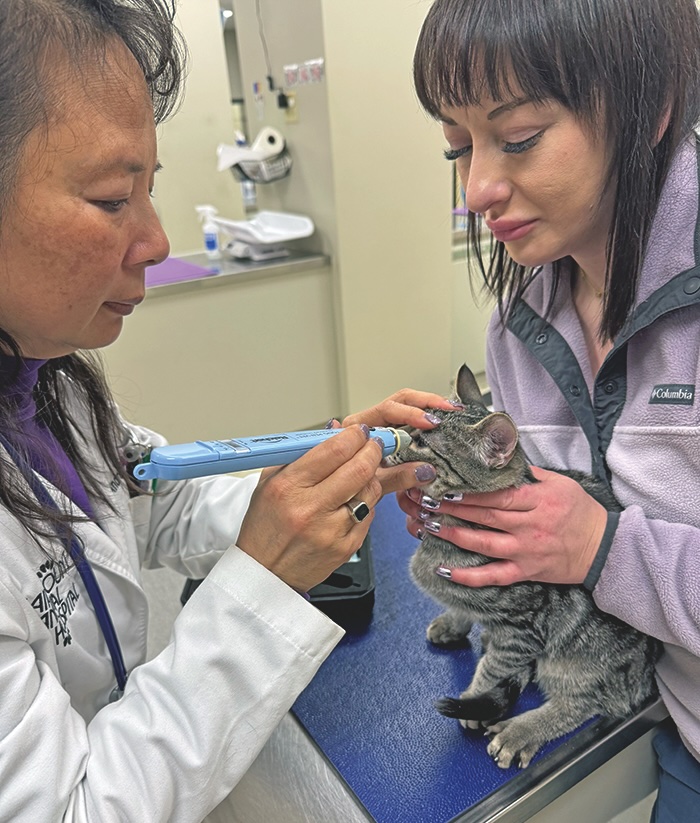
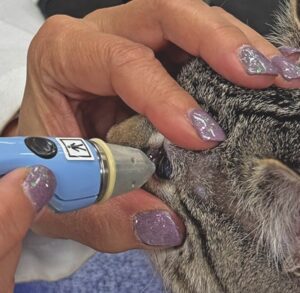
“To diagnose glaucoma, we measure your cat’s eye pressure using a small handheld tool called a tonometer,” says Dr. Plotsker. “This test is quick and does not hurt. We use numbing eye drops, and the device gently touches the surface of the eye.”
Normal IOP for cats is 10 to 25 millimeters of mercury (mmHg). Anything over that is diagnostic for glaucoma. Occasionally, if a cat is super stressed during the exam, or if too much pressure is applied to the head or neck during restraint, the IOPs may be falsely elevated. Your veterinarian is aware of this possibility and will factor it into your cat’s assessment.
 Treating Glaucoma in Cats
The goal of treatment for glaucoma is to achieve and maintain normal IOP in both eyes, thereby alleviating pain and preserving vision. In addition to direct therapy to lower IOP associated with glaucoma, any underlying disease must be identified and treated. There are basically two ways to lower IOP:
Decrease the production of aqueous humor
Increase the drainage of aqueous humor
In cats, medications that decrease the production of aqueous humor are the treatment of choice. These medications are called carbonic anhydrase inhibitors. Topical therapy with eye drops containing dorzolamide hydrochloride 2% (Trusopt) or dorzolamide hydrochloride 2% with timolol maleate 0.5% (Cosopt) are usually first-line choices. Timolol, a beta-blocker, should be used with caution in asthmatic cats or cats with heart disease. Additionally, diabetic cats should have their blood sugar carefully monitored while using timolol.
Review of the veterinary literature suggests that a promising new topical therapy for glaucoma in cats who don’t respond to standard glaucoma therapy may be coming.
Omidenepag isopropyl is a selective prostaglandin E2 receptor agonist that reduces IOP by increasing the drainage rate of aqueous humor. It is used in humans, and studies have shown it to be effective in cats. It is still being studied, however, and has yet to be formally approved for use in cats.
What to Expect
If your cat is diagnosed with glaucoma, expect lots of monitoring in the beginning until IOP is normalized. Expect treatment, if successful, to be for life. If treatment is not successful, the recommendation is usually to have the eye removed (enucleation) since glaucoma can be excruciatingly painful for your cat.
It’s obviously worth the effort to try and save your cat’s eye, but if this can’t be done, alleviation of pain becomes the primary goal of treatment. Importantly, cats that undergo enucleation most commonly adapt extremely well to life with one eye.ν
Eye pressure is measured using a tonometer. Although not painful, numbing drops are used because the tool does touch the surface of the eye.
Photos courtesy Dr. Eileen Fatcheric
“Cats with eye pain may squint, have watery eyes, or hide more than usual,” says Dr. Noah Plotsker, DVM.


