

The most common lower urinary tract problem in cats under 10 years of age is feline idiopathic cystitis (FIC). As its name implies, FIC refers to a condition in which the bladder wall becomes inflamed (cystitis) without any identifiable medical cause (idiopathic).
FIC can be a challenging illness to manage because, like its human counterpart, it is usually due to psychological stress. FIC-susceptible cats are super stressed by some events that may be more obvious causes of stress but can also respond negatively to less obvous sources of stress, including a family argument or something as simple as rearranging furniture. All cats prefer routine, but these cats truly need stability in their lives.
How Does FIC Develop?
Urine can be irritating to the inner bladder wall due to variations in pH, the presence of toxins in the urine, and the formation of urinary crystals that can “rough up” the mucosal lining of the bladder.
To protect itself from such irritation, the bladder has glycoproteins called polysulfonated glycosaminoglycans (PSGAGs) that line its inner wall, providing a protective layer. However, for reasons that are not fully understood, if your cat becomes anxious or stressed, this PSGAG lining can thin or become patchy, exposing the underlying bladder wall to irritation, which leads to inflammation.
 FIC-susceptible cats can become anxious due to a variety of environmental stressors, including conflict with other pets, new pets/people in the home, the loss of pets/people within the home, moving to a new home, construction within or outside the home, stray/outdoor cats that can be seen through windows, changing foods, or even something as simple as a new work schedule. These cats are very sensitive to changes in their lives.
Signs of FIC
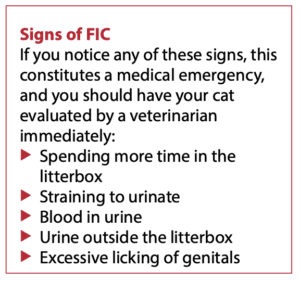
Your cat may spend more time than usual in the litterbox and may strain to urinate. She may cry out in pain while straining, and you may notice blood in the urine. She may start inappropriately urinating outside of her litterbox, and you may see her licking her genital region excessively. If you notice any of these signs, this constitutes a medical emergency, and you should have your cat evaluated by a veterinarian immediately.
Diagnosis
FIC may mimic other causes of feline lower urinary tract disease (FLUTD), including bacterial infection, urinary crystals/stones, and some forms of cancer so it can be difficult to know if an affected cat’s symptoms are due to one of these other medical causes or to FIC without appropriate diagnostic testing.
There is no specific diagnostic test for FIC, as its diagnosis is one of exclusion (i.e., it is presumptively diagnosed by ruling out all other causes of observed symptoms). Your veterinarian will usually collect a urine sample after taking a thorough history and performing a physical examination.
The ideal sample is collected by cystocentesis, a procedure that involves the passage of a small needle through the abdominal wall into the bladder. While this may sound invasive, cystocentesis is generally very safe and well tolerated by most cats, although some may require mild sedation for this procedure. It is the best way to obtain a urine sample in that it provides a sample directly from the bladder, before it is contaminated by bacteria and other cells that are found in the urethra and external genitalia (these contaminants are commonly found in voided urine samples). This is important because a urine sample obtained via cystocentesis is the best representation of what is going on in the bladder itself.
The urine sample will be microscopically examined for red blood cells, white blood cells, bacteria, crystals, and abnormal cells that might be cancerous. The pH and concentration will be checked to help determine whether your cat’s kidneys are working well.
A culture of the urine will usually be recommended if microscopic analysis suggests the possibility of bacterial infection to identify potentially causative bacterial species so that antibiotic therapy can be appropriately targeted. Abdominal X-rays and/or ultrasound may be recommended to rule out bladder cancer and/or urinary calculi (stones).
Some cats may have multiple urinary problems at the same time, such as a urinary obstruction (more common in male cats). One study, for example, showed that up to 15% of cats diagnosed with FIC experienced urethral obstruction, a potentially life-threatening complication.
Management
The treatment of FIC involves management strategies designed to stabilize any acute urinary issues (i.e., urethral obstruction) and to prevent recurrence. Many affected cats will benefit from antispasmodic medications that relax the bladder wall and/or the sphincter that controls the release of urine into the urethra, pain medications, and/or tranquilizers.
Managing your cat’s environment to minimize stress is vital in reducing the likelihood of FIC recurrence. The Feline Veterinary Medical Association recently released a new statement to help cat owners focus on the physical and emotional needs of cats. These “Five Pillars of Feline Needs” include:
- Provide a safe place
- Provide multiple and separate key environmental resources (i.e., food, water, litterboxes)
- Provide opportunities for play and predatory behavior
- Provide positive, consistent, and predictable human-cat social interaction
- Provide an environment that respects the cat’s sense of smell and other senses
Following these guidelines can help reduce stress in indoor cats and can help limit predisposing factors for FIC.
 In keeping with these guidelines, we suggest that you take steps to ensure your home is as cat friendly as possible, including:
Litterbox: You should ideally have one litterbox for each cat, plus a spare. Litterboxes should be in a quiet place where a cat can’t be ambushed by another pet. They should be easy to access, and filled with the litter your cat prefers.
Water: Your cat should always have fresh, clean water available, so she consumes enough to flush her irritated bladder. Be sure to rinse and clean bowls daily. Some cats prefer running water such as can be provided by a pet water fountain. Sometimes even just changing the type of bowl, such as from ceramic to stainless steel, may make a difference in your cat’s water consumption.
Food: Canned food is usually recommended, as it contains more water than dry foods, but you can also add water to dry cat food to help assure adequate water consumption.
Obesity: Obesity is a predisposition for many health problems, including FIC, so a weight-loss program developed in consultation with your veterinarian should be pursued for cats that are overweight.
Resources/Enrichment: Multi-cat households can be stressful. Each cat needs access to a quiet, safe place they can retreat to when they feel overwhelmed. This might be something as simple as a cat tree or a separate room with appropriate resources provided.
Speaking of resources, these should always be easily available for each cat, so provide three food bowls for three cats, for example. Putting out an extra cat bed and having an extra litterbox are both good ways to reduce stress.
Make sure you plan time every day to give each cat individual attention. This doesn’t need to be too onerous, but a special time for some lap snuggling, gentle grooming, or playing with a favorite toy can all be important. Your cat will likely look forward to it.
Aim for a quiet environment to ease your cat’s senses. Loud music, flashing lights, and strong odors may be offensive to any cat, let alone a sensitive one.
While studies showing a direct benefit of the use of calming pheromones are currently lacking, these may help to keep your cat settled, particularly in multi-cat households.
When you have an FIC susceptible cat as part of your family, it is wise to forego activities like fostering. Limiting numbers and not replacing cats who have passed can make life simpler for these cats.
Routines: Cats susceptible to FIC do best with regular schedules. The same food, fed at the same time every day, the same schedule for human activities, etc. is ideal. That is not always possible, of course, but do the best that you can.
For severe cases, behavior-modifying medications and supplements may be prescribed. The catch here is that unless this substance is something your cat will eat on her own, you will have to medicate her. And giving medications can be stressful for you and your cat!
One of the easiest methods is to use a tube of flavorful food/treat in which you can hide the medication.
You can also consider flavored liquid compounded medications and/or transdermal preparations (where available) that can be applied to the skin to minimize the stress of medicating your cat.ν
(continues on next page)
∞ illness
“There is no specific diagnostic test for FIC, as its diagnosis is one of exclusion.”
Signs of FIC
If you notice any of these signs, this constitutes a medical emergency, and you should have your cat evaluated by a veterinarian immediately:
Spending more time in the litterbox
Straining to urinate
Blood in urine
Urine outside the litterbox
Excessive licking of genitals


