
Capnocytophaga is a genus of bacteria that occurs naturally in your cat’s mouth. Most of the time it does not cause any trouble for anyone, but on rare occasions, it can cause health issues for people who are bitten or scratched by cats. This most commonly occurs in people who are immunocompromised.
You’ve Probably Been Exposed
“Animal contact and bite history can be really important when someone gets sick, and it takes seconds to ask, but too often the question is never asked. That’s a healthcare gap. At the same time, we need better education of the public so that people can advocate for themselves and know to tell healthcare providers about animal contacts, especially animal bites,” says J. Scott Weese, DVM, DACVIM, professor of pathobiology at the Ontario Veterinary College and host of the Worms & Germs Blog.
Capnocytophaga canimorsus and Capnocytophaga cynodegmi can both be found in a healthy cat’s mouth. If you have loved multiple cats in your life, you have probably been exposed to one or both. Studies suggest that C. canimorsus can been found in 21% to 57% of cat mouths and that C. cynodegmi can be found in 84% of cat mouths.
In general, it is rare for Capnocytophaga to cause harm to humans or cats. If an infection does occur in humans, C. canimorsus is more likely to cause severe illness. In rare cases, these bacteria have been found to cause stubborn respiratory infections in cats.
Who’s At Risk
As with most opportunistic infections, healthy cats and humans have a low risk of Capnocytophaga infection.
Humans who are immunocompromised, do not have a spleen, or suffer from alcoholism are more susceptible to infection. Although these infections are rare, they can be severe and can progress to multiple organ failure and circulatory problems. In recent studies of infections in people:
54% of infections occurred after being bitten by a cat or dog.
9% of infections occurred after being scratched by a cat or dog.
27% of infections occurred after close contact with a cat or dog.
Cats who are immunocompromised are likely at higher risk, but known cases of Capnocytophaga infection in cats are so rare that we don’t have much data on it.
Wound Care Is Critical
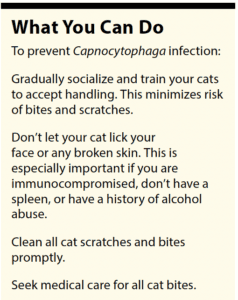
The best way to protect yourself and loved ones is to clean all bite and scratch wounds promptly. This is good practice to prevent many infections, not just Capnocytophaga!
Cat bites are notorious for becoming infected because they tend to be deep and narrow, creating the perfect warm, dark environment that bacteria love. We strongly recommend seeking medical care for any cat bite, but this is especially critical for immunocompromised persons.
Advising your healthcare provider about any cat bites or scratches can aid in getting a faster diagnosis and treatment.
Capnocytophaga grows slowly, so arriving at a definitive diagnosis of infection via bacterial culture can be tricky. Cultures are more likely to be successful with blood or bodily fluid samples than from a swab of a bite wound. PCR and molecular biologic tests are generally the best way to identify Capnocytophaga species.
Treatment commonly includes antibiotics like penicillin or amoxicillin-clavulanate acid combined with supportive care as needed.
Bottom Line
Any time a person gets sick, it is a good idea to consider any recent animal bites or injuries. They’re easy to forget about, especially if it seems to be a minor wound or scratch, but you should be aware.
 Capnocytophaga infection is not something that most cat lovers need to worry about. It’s something you need to be aware of, especially if you get sick after being bitten by a cat or your feline friend has a persistent respiratory infection.
If you are immunocompromised, do not allow your cat to lick your face or any broken skin, and seek medical care promptly for all cat bites, even if they don’t seem that bad. Prompt, thorough cleaning of wounds and preventive antibiotics can improve outcomes in most cases.
We strongly recommend seeking medical care for any cat bite. . . . Advising your healthcare provider about any cat bites or scratches can aid in getting a faster diagnosis and treatment.


