
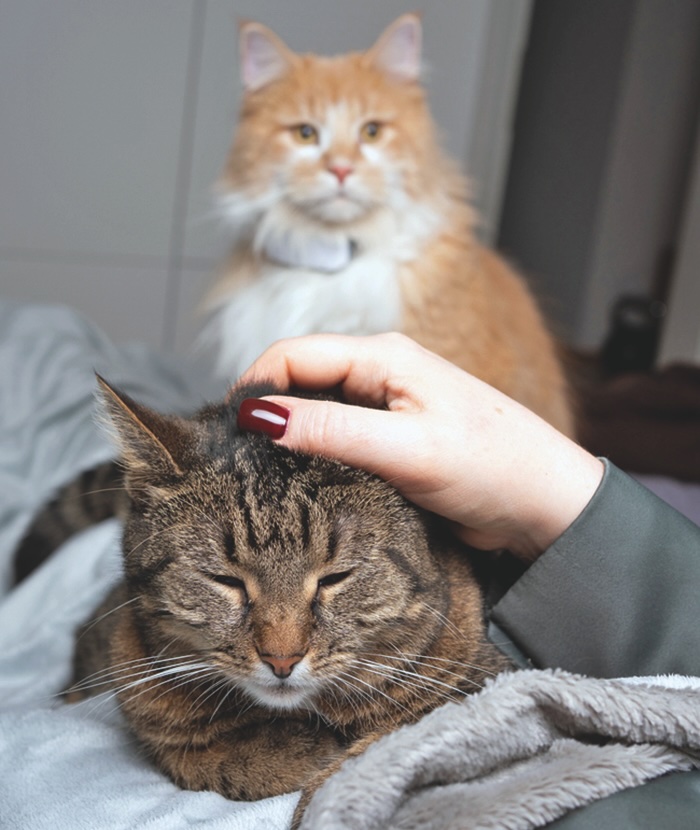
There is no objective way to measure emotions, but most cat lovers can identify things like a stiff tail, raised hackles, and accompanying growls as angry, or at the very least, very unhappy. In contrast, your cat curled up on your lap, kneading and purring is surely happy and content. All anecdotal, but probably accurate.
“We can recognize basic emotions like fear, aggression, and contentment (purr treading, squinty eye), but more subtle things like hurt feelings are harder,” says Kathryn Houpt, VMD, PhD, Emeritus Professor of Behavior at Cornell University’s College of Veterinary Medicine. “Maybe disappointment: If your dog jumped on your lap when the cat was expecting to get there would qualify,” she says.
“Getting another cat would certainly hurt a cat’s feelings. Many cats prefer to be solitary. Whether cats are cognitively aware of their relationships with the people in their home and react when their expectations aren’t met is a good question. I think the answer is yes, but I am not sure how to prove that,” says Dr. Houpt.
“If a cat walks away lashing her tail, it is fairly obvious that she is annoyed, which could be an indication of hurt feelings. An expectation was not met. I hypothesize that the cat thinks, ‘That blankety-blank dog got attention I wanted,’ not, ‘Oh dear, my owner likes the dog better,’ ” says Dr. Houpt.
Expectations
Having hurt feelings implies many emotions at once. If you expect to have steak for dinner and get canned meat, you might feel angry, frustrated, sad, or unhappy. Your emotions are tied into what you thought would happen.
Your cat, on the other hand, tends to live in the minute. She knows that 6 p.m. is approaching and she will get fed. She might prefer tuna over beef-flavored food, but she is likely not going to be emotional over the choice. She may choose to walk away from the food she doesn’t like as much, but she is not holding it against you. If you are half an hour late with dinner, she may act anxious or upset because dinner usually comes right on time, but whether this is a true emotion is debatable.
Angry Cat
It is not believed that cats do things out of spite. You are an hour late getting home from work, her dinner will be served an hour later. Your cat is likely not sitting around thinking how angry she is that you are late.
She also is not worried. On the other hand, she may get bored and start looking around for something to do. Ah, toilet paper! That is fun to roll and shred. Or, hmmm, the dirt in this planter would be interesting to dig around in. No malice. No forethought.
Even things like marking by peeing on someone’s shoes is more of an, “I will mark this so this person knows that I am here,” than an, “I hate this person so I will show that by peeing on his possessions.”
While people can be adept at disguising their true emotions and feelings, when your cat shows her true colors about a certain situation, it is a true, simple gut response. She is not concerned about how her angry swat at you as you clip her nails may make you feel. She is simply angry, or at least unhappy, about being restrained. She stalks away to remove herself from the chance you might want to do some more restrained care, not because she is “upset at you.”
Similarly, if you groom Fluffy before Tiger, Tiger isn’t feeling upset that she went second. She may be upset that Fluffy got treats before she did, but that is a concrete event, not a feeling.
People who have a close bond with their cats can often read their emotions. Subconsciously, they read their cats’ body language and vocalizations.
A “tuned-in” owner knows if her cat is asking for water, food, or just some time and petting. For those with a tight human-animal bond, the distinction between their pets’ emotions and feelings is usually irrelevant. They just seem to know.


