
Management is a key component of treatment for feline pancreatitis, which is probably more common than we realize. The American College of Veterinary Internal Medicine published a consensus statement on pancreatitis in cats, citing a study that showed 66.1% of 115 cats undergoing necropsy at the University of California Davis had evidence of pancreatitis. Of the apparently healthy cats in the study, 45% had pancreatic lesions.
These numbers are compelling and may mean pancreatitis is sometimes missed. This may be partially due to the cat’s notorious ability to hide low-grade symptoms of disease, making it seem like an illness has come on suddenly, when in reality the problem has been smoldering for months.
“Pancreatitis in cats can be either acute or chronic, though acute cases tend to be more 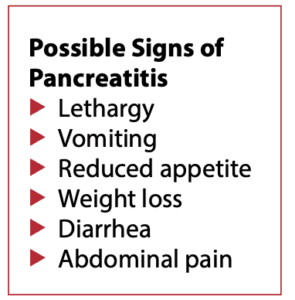 clinically severe,” says Dr. Alyssa Chandler, DVM, ACVIM, Professor in the Section of Small Animal Medicine, Cornell University’s College of Veterinary Medicine.
“While we don’t typically identify the cause of pancreatitis, certain conditions like diabetes, chronic gastrointestinal disease, hepatic lipidosis, and cholangitis have been associated with pancreatitis in cats,” she says. “In pancreatitis, release and activation of pancreatic digestive enzymes results in autodigestion of the pancreas, which can manifest as clinical signs including lethargy, anorexia, vomiting, diarrhea, and weight loss.”
What Is the Pancreas?
The pancreas is a sensitive little organ. It’s so sensitive that, if your cat is undergoing abdominal surgery for something else (e.g., spay, GI foreign body removal), the veterinary surgeon must be careful to avoid touching the pancreas as much as possible as this can result in acute pancreatitis. Imagine how damaging and painful it must be when the pancreas starts trying to digest itself.
In addition to acute or chronic, pancreatitis can sometimes be chronic-active, which results in waxing and waning intermittent signs. Cats with chronic-active disease need observant owners and treatment administered as needed when symptoms appear.
“There is no perfect test for pancreatitis, and thus the diagnosis is typically made via a combination of history, clinical examination, lab work findings, and abdominal ultrasound,” says Dr. Chandler. An abdominal ultrasound is generally better at detecting pancreatitis than abdominal X-rays are. But don’t be surprised if your veterinarian recommends an X-ray first, especially if your cat is vomiting. X-rays are important to rule out other causes of vomiting, and they are readily available at your primary-care veterinarian’s office. Ultrasound may require referral.
Bloodwork usually includes a baseline chemistry screen, complete blood count, and a feline pancreatic lipase immunoreactivity assay (fPLI). The fPLI is one of the most sensitive and specific tests we have for feline pancreatitis, making it extremely useful. Further testing to rule out the common concurrent issues mentioned above is recommended on a case-by-case basis.

Treating Pancreatitis
“Treatment is largely supportive and includes fluid and electrolyte therapy, nutritional support, pain management, and anti-nausea medications,” says Dr. Chandler. “Most cats recover well with care; however, more severe cases are associated with a worse clinical outcome.”
Supportive care for feline pancreatitis usually includes fluid therapy as needed for dehydration, anti-vomiting medications like maropitant (Cerenia), anti-nausea medications like ondansetron (Zofran), appetite stimulants like mirtazapine or capromorelin (Entyce, Elura), and most importantly pain management. Gabapentin and opioids, like buprenorphine or tramadol, may be prescribed in varying combinations.
Antibiotics are not indicated for feline pancreatitis unless pancreatic infection or abscesses are suspected or diagnosed. Immune-modulating medications may be prescribed in some cases of chronic pancreatitis if underlying immune disease is suspected.
Nutritional support is of utmost importance when treating feline pancreatitis.
Persistent anorexia increases risk. Allowing anorexia to hang on increases the risk of secondary issues like hepatic lipidosis (fatty liver), low protein levels, and intestinal damage. If mirtazapine or capromorelin doesn’t get your cat eating, your veterinarian may recommend placement of a feeding tube.
While some cases of feline pancreatitis can be severe and even fatal, there are plenty of cases that respond well to appropriate medical management. The key is to recognize the signs and seek veterinary attention right away.
If your cat is showing vague signs of not feeling well pancreatitis is a possibility. Remember, cats are good at hiding signs of serious disease and feline pancreatitis is more common than we may think.


