
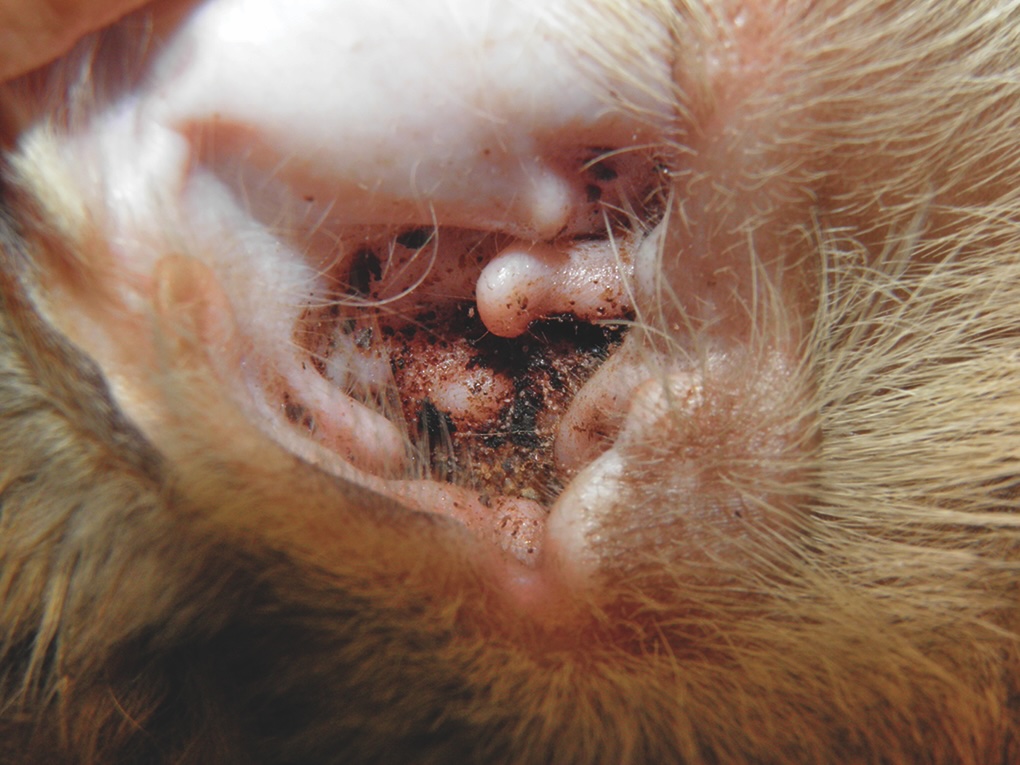
If your cat or kitten is scratching at his ears and shaking his head, ear mites are probably one of the first things on your mind. “In the cat world, being ‘up close and personal’ is likely to get you ear mites,” says William H. Miller Jr., VMD, ACVD, Professor Emeritus of Medicine in the section of dermatology at Cornell University’s College of Veterinary Medicine.
Mighty Mite
The tiny mite Otodectes cynotis prefers to live inside the ear canals and on the skin of cats and dogs. Ear mites spend their time feeding on skin cells, ear wax, and other tissue fluids and reproducing. An ear mite infestation is very itchy, causing your cat to shake his head and scratch his ears. Buildup of waste and debris creates a dark, gritty discharge inside the ear that looks like coffee grounds.
“People think ear mites only live in the ear, but that’s not true,” says Dr. Miller. “They can be all around the mother’s face, and she can transfer them to the kittens when she grooms them. Depending on the mother’s parasite load, the mites can be found all over her body and transfer to the kitten when it nurses.”
Ear mites are most often found on kittens, but any cat can become infected. “In adult cats that are fully furred, transfer is most likely to occur when they are rubbing faces. The mite can live off the host for a short period, so a heavily infested cat can contaminate a bed or nesting box. The next visitor to the bed would be exposed.”
Cats usually get ear mites from other cats or from wildlife if they spend time outside. A common scenario in veterinary clinics is an adult cat picking up ear mites from the family’s new kitten.
Diagnosis
While the classic coffee-grounds debris in the ears is a good indication that your cat has ear mites, it is not a guarantee. Cats can also get bacterial and yeast infections in their ears, and all these issues can have variable appearance.
Ideally, your cat should have a veterinary exam to diagnose the cause of his itchy ears and then start an appropriate treatment. If your cat has a heavy infestation of ear mites, your veterinarian may be able to see the mites crawling around when she investigates the ear with an otoscope. If not, a staff member can take a quick swab of the ear and look at it under a microscope. When looking for ear mites the swab is rubbed on a glass slide and a drop of mineral oil is added on top. Mites and/or their eggs are usually easy to identify as soon as the microscope is focused.
If ear mites are not found, your veterinarian will recommend a full ear cytology, where the sample from the ear is rubbed on a slide and then stained to make bacteria and yeast more visible.
Fun fact: If a cat has a severe ear mite infestation, dead ear mites might be found on a fecal exam. This is because the cat swallows mites when grooming.
Treating Ear Mites
Milbemycin (brand name MilbeMite) is a common treatment choice for ear mites in cats and kittens. It is a one-time treatment that is instilled directly into the ear.
Selamectin (brand name Revolution) is another popular option to treat ear mites. Revolution also prevents fleas for a month and helps to prevent heartworm, roundworm, and hookworm. Revolution Plus also includes sarolaner as a tick preventive. Both products are applied to the skin once a month.
Other preventive medications intended for fleas and ticks may also be used off label to treat ear mite infections. Ask your veterinarian if your preferred flea and tick preventive is also effective against ear mites.
Keep a close eye on all other cats in your household, as this parasite is highly contagious. It may be necessary to treat all pets in your home.
Home Remedies
While a prescription medication is ideal, ear mites are one of the few feline maladies where a home remedy may be effective. “An old-time treatment which worked most of the time was baby oil put in the ears every other day for a month. The oil would smother the mite,” says Dr. Miller. “If the body was infested, then a pyrethrin flea spray would be applied, per label, for the month. The kitten was a real grease bag, but the treatment was safe and effective for all those barn kittens that wouldn’t be treated otherwise.”
If using a pyrethrin flea spray, it is critical that you use a product intended for use in cats. Follow all instructions carefully. While these products are safe when used correctly, they can be extremely toxic to cats if the cat is given too high of a dose or a product intended for use in dogs. Double and triple check the label and instructions before purchasing a pyrethrin flea product for your cat and before using it (or better yet, schedule a veterinary appointment to get a safer prescription option).
If your cat or kitten’s ears don’t clear up, it may be that his ear woes were not caused by ear mites. In this case, it is time to make a veterinary appointment to diagnose and treat the cause of his itchy, dirty ears.
“An old-time treatment which worked most of the time was baby oil put in the ears every other day for a month. The oil would smother the mite,” says Dr. William Miller.


