
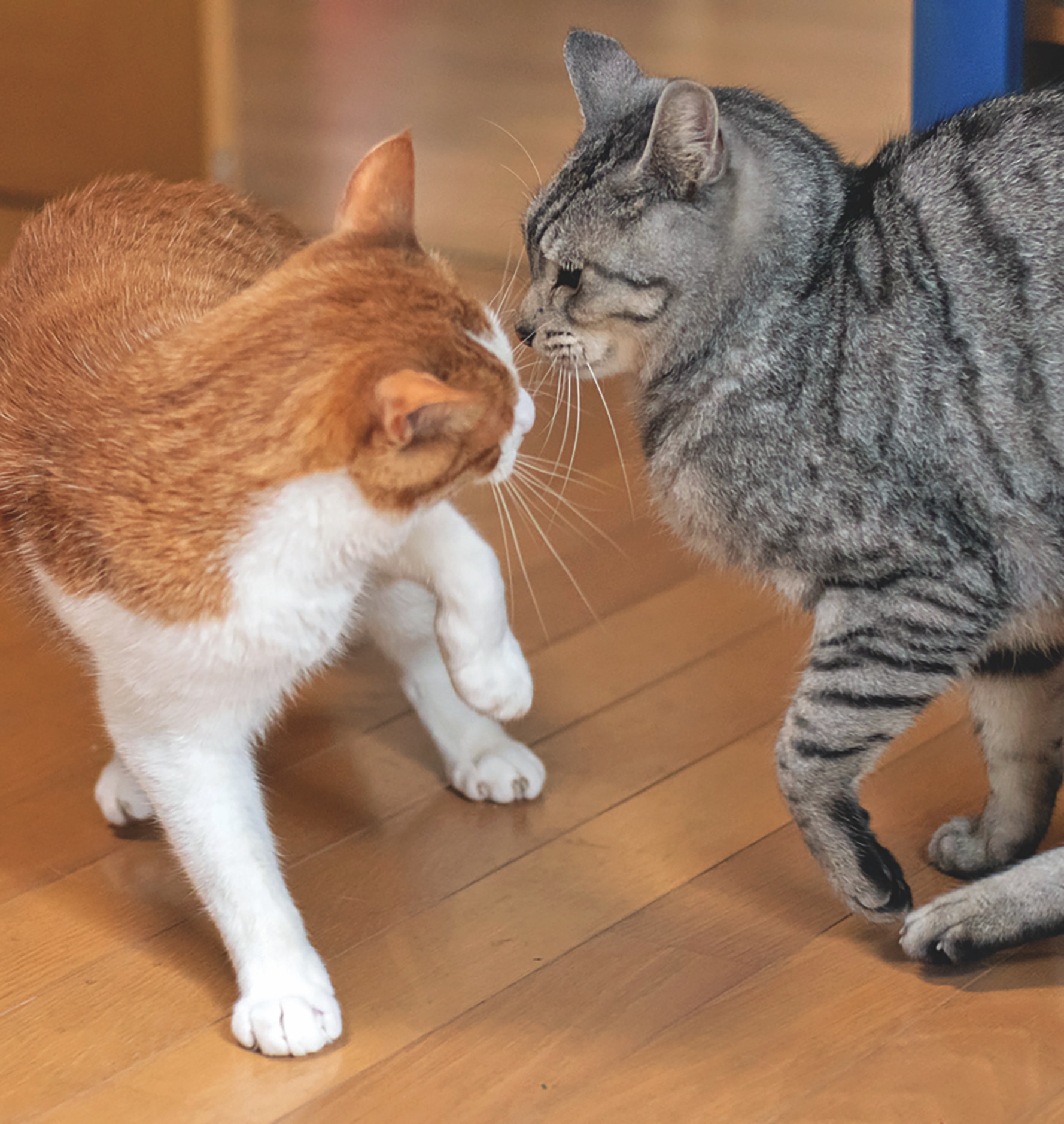
You just got a new cat and your senior cat keeps trying to attack her. What do you do now?
“The cats should be separated to prevent the aggression/conflict from escalating,” says Pamela J. Perry, DVM, PhD, board-certified veterinary behaviorist for the Camuti Consultation Service at Cornell University’s College of Veterinary Medicine. “Give both cats equal but separate key resources such as food, water, litterboxes, scratching areas, resting places, etc.”
Once the cats have been separated and had time to cool down, you can start gradually building their relationship.
Positive Associations
Your goal is to let the two cats become used to each other and to teach them both that the other cat is either a good thing or at least neutral. Start with the two cats on either side of a solid barrier so that they cannot see or touch each other. They will still be able to smell and hear the other cat.
“Reward both cats for calm behavior on opposite sides of the door that separates them,” says Dr. Perry. The reward might be special treats, a favorite toy, or petting, whatever each cat enjoys and values. You are teaching your senior cat that when she is near the newcomer, good things happen. Repeat this throughout the day for several days.
You can also give the cats a chance to check each other out remotely. “Rub each cat’s cheeks/chin area with a cloth and give it to the other cat to investigate,” says Dr. Perry.
The cloth will take up some of the cat’s facial pheromone, a pheromone that your cat uses to mark familiar and pleasant things. After rubbing a cloth on each cat’s face, give the cloths to the opposite cat. This allows the cats to smell each other without direct contact.
“As both cats become comfortable with the other’s presence with a solid barrier between them, the barrier can be slowly diminished,” says Dr. Perry. “Replace the door with two baby gates stacked in the doorway and cover them with a heavy blanket, etc.” Make the change at a time of day when both cats are typically relaxing, not an exciting time like meals or playtime.
The next step is to remove the blanket from the gates so the cats can now see each other directly. “Do not progress too quickly—each cat must be comfortable with each step before proceeding,” says Dr. Perry. Once again, make this change at a time when the cats are calm. Watch how they react but let them approach the gate at their own pace. If either cat seems agitated, keep the gate covered when you cannot supervise them.
After a few days you can also swap the cats’ rooms, so they have a chance to check out each other’s space and do not become too territorial of their original rooms.
When both cats are calm while able to see each other, especially if they interact peacefully at the gate, you can allow them some supervised visiting time when the gate is open. It is OK if the cats choose to stay in their rooms and do not interact while the gate is open. They will come out at their own pace.
Over time, increase the length of their supervised interaction time. Once you are confident that both cats are comfortable with each other, you can allow them to be together all the time.
Kitten Manners
Kittens can be rude or too pushy with older cats. Play with your kitten frequently to help her burn some energy. Distract and redirect with a toy if she tries to tackle the older cat. Protect the senior cat so she doesn’t want to discipline the kitten.
Cats don’t have to be best friends to live in peace. But with time and patience, your young cat can learn how to be respectful of your senior cat, and your senior cat can learn to tolerate the newcomer.


