
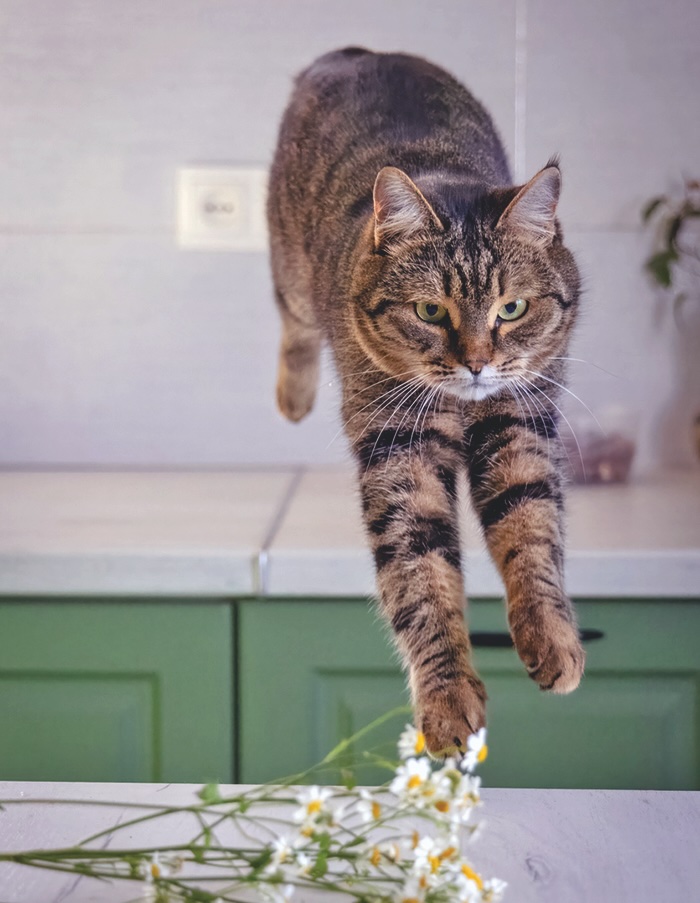
Your sweet ball of fluff who would sleep on your lap for an hour or more while you read is suddenly a whirling dervish of teeth and claws. What happened?
Adolescence! Your cute kitten is now a teenage cat with the energy of five highly caffeinated drinks.
Pamela Perry, DVM, PhD, is a board-certified animal behaviorist at the Cornell University Hospital for Animals and has experienced feline adolescence in person, times four! “I adopted four kittens about 10 years ago, and I got to experience feline adolescence in exponential form,” says Dr. Perry. “My best advice is lots of enrichment and patience—and cat-proofing the home. Cats are very inquisitive creatures and utilize all dimensions (i.e., including vertical space).
 “Providing shelves or perches can be helpful as can lots of interactive toys. Suitable scratching surfaces located in prominent, well-traveled areas are essential. It’s important to focus on rewarding good behavior rather than punishing bad behavior,” says Dr. Perry. “If the cat is doing something that is unacceptable, then figuring out why the cat is doing it and providing an alternative outlet for that behavior is beneficial for everyone.”
Signs of Adolescence
Scratching is a bad habit that may increase during adolescence. Make sure your cat has plenty of approved scratching options in the form of scratching posts. Try to figure out what options your cat prefers. Natural wood? Carpet? Sisal? Also, some cats prefer a horizontal scratching option to a vertical one.
Sprinkle catnip on whatever surface you want your cat to scratch if she is a cat who likes catnip. Offer her good things to scratch but keep her nails trimmed. Both will help prevent damage to items you don’t want scratched.
Attacking plants can also be a fun adolescent cat activity, at least in your cat’s opinion. Put pots where they can’t be knocked over. Make sure any plants your cat can access are safe. Consider growing a small plot of cat-safe grasses for your cat to chew on.
Feline hormones kick in early on, sometimes as early as 4 months, though most cats experience adolescence between 6 and 9 months of age. For both sexes, though more common in males, urine marking can start at this time. When spraying, your cat will back up to furniture or some other surface, raise his tail, and literally spray some urine, saying, “I was here.”
Your adolescent female cat may wake up one morning and seem to have gone crazy. She may cry, stretch out, roll over screaming, and have a total behavior change from her normal sweet self. All this is typical for a cat in her first heat. Luckily, cats can be safely spayed while in heat as opposed to dogs. Schedule a spay or neuter as soon as possible to help break bad behaviors early on, which is usually much more successful than after the habit is established.
Physical Exercise
Start with exercise. A flirt pole, which is a long wand with a ribbon, feathers, or toy on the end, can keep your cat jumping and bouncing while you sit. If your cat retrieves, and many do, this is a good time to reinforce that game. Many cats will retrieve small toys, and almost all cats will retrieve a crumpled ball of aluminum foil. Just don’t leave that around for your cat to chew on.
If your cat has been harness-and-leash trained, step up your walking schedule. Remember to use safe locations, like doing laps around your fenced yard. If you have been thinking about building a catio (outdoor enclosed patio for your cat), now is the time. You can build a makeshift agility course out of items to jump or climb onto using a variety of items you have at home.
Mental Exercise Is Fun and Healthy
Along with physical exercise, mental exercise can also “wear out” your exuberant teenager. Shift to a snuffle mat or food puzzles for your cat’s meals. You can also do a “kibble scatter” so she must hunt down her dinner. Hiding treats around the house also provides your cat with both physical and mental exercise.
Scent work, or nose work, is a big sport for dog owners. Cats have a great sense of smell, too. The internet is full of videos showing how to teach this activity to your cat, who will enjoy the hunt.
With patience and great treats, your cat can learn to do all the tricks your dog does. Sit, down, and shake are easy to teach most cats. You can follow similar strategies used in dog training (there are many online training resources) if you need guidance.
Also, remember to use tiny tasty treats and to include your cat’s treat intake as part of her daily food allowance to avoid inappropriate weight gain.


