
Your cat has a chronic health condition, and your veterinarian has recommended a prescription diet. But that price tag is higher than what he had been eating. Is it worth the price tag and hassle in ordering or purchasing?
“Plenty of issues in cats can be dramatically improved on a therapeutic diet,” says Joseph J. Wakshlag, Ph.D., DVM, ACVN, ACVSMR, Professor of Clinical Nutrition and Sports Medicine and Rehabilitation at Cornell University’s College of Veterinary Medicine. In some situations, a prescription diet is absolutely worth the price and effort, but in others you may still be able to help your cat by carefully choosing a suitable over-the-counter diet.
What Is a Prescription Diet?
Prescription or therapeutic foods are formulated to treat or manage specific diseases and health conditions. Each food has set purposes and goals. These goals might be as straightforward as providing a low-caloric-density food that is still nutritionally complete to support weight loss, or as complex as supporting kidney function while also preventing the development of bladder stones for a cat battling both urinary issues and chronic kidney disease.
 Companies formulating prescription diets need to understand how nutrition interacts with each disease process, design a food that meets those needs, and then prove through research that their product delivers.
Remember that the needs of sick cats do not always line up with the needs of healthy cats. Kidney disease is a prime example. As obligate carnivores (meaning cats must eat meat), healthy cats consume high amounts of protein. But protein puts extra strain on damaged kidneys. Because of this, foods designed to help cats with chronic kidney disease have drastically lower amounts of protein. These diets are not complete and balanced according to the American Association of Feed Control Officials (AAFCO) standards for healthy cats, but they are the best option nutritionally for cats with kidney disease.
The cat foods we see on store shelves should all have an AAFCO statement assuring that the diet is complete and balanced for one or more life stages. This ensures that the food meets the needs of healthy cats. While some prescription diets are also complete and balanced, others are not. This is because the therapeutic diet addresses the unique nutritional needs of cats with a specific health condition and has been tested to prove that it does.
When to Choose Prescription
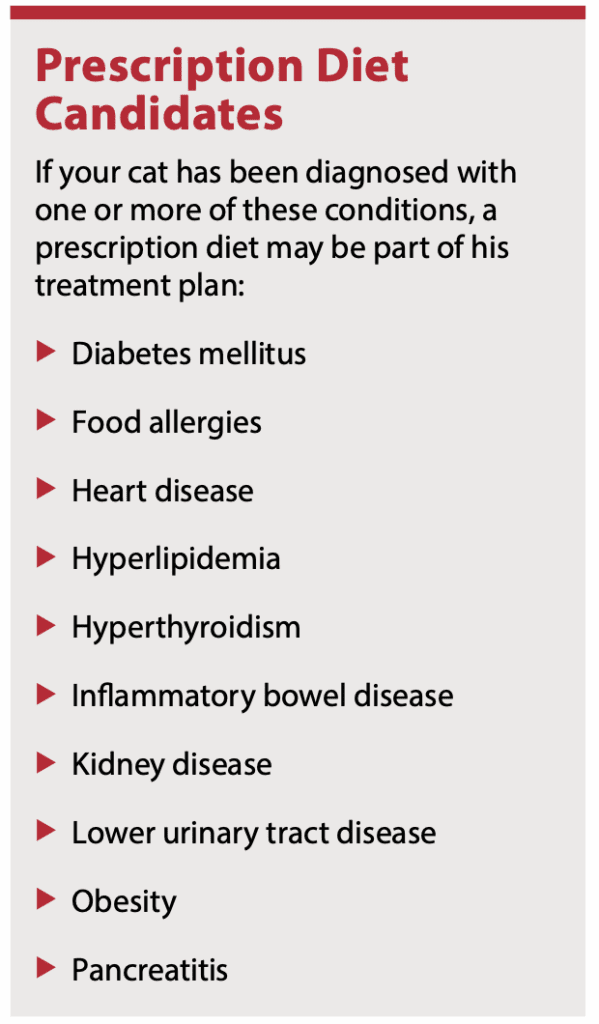
“For problems such as inflammatory bowel disease, skin-related food allergy, lower urinary-tract disease, kidney disease, and hyperthyroidism, a therapeutic diet is likely the best option due to the way the foods are made,” says Dr. Wakshlag. “Over-the-counter foods will not work since they have to comply with AAFCO standards and therapeutic foods from vets do not have to meet these standards.”
Some of these health problems can be treated without dietary changes. For example, hyperthyroidism can be cured with radioactive iodine therapy or managed with lifelong medication. But if you want to solely use food to address hyperthyroidism, the prescription diet is an absolute must.
In other cases, the therapeutic diet will be combined with other treatments. For example, a cat with inflammatory bowel disease might also take probiotics and immunomodulating medications in addition to eating a prescription food.
Shopping Around
“Other issues such as obesity, diabetes, hyperlipidemia, pancreatitis, and heart disease are areas where one can find over-the-counter options that may be sufficient to help with the disease process, and a therapeutic diet is not always needed,” says Dr. Wakshlag.
If your cat is diagnosed with one of these conditions, your veterinarian will explain what characteristics you should look for or avoid when choosing a food. For example, cats with diabetes generally benefit from low-carbohydrate diets, while cats with pancreatitis may benefit from low-fat diets. Once you know what your cat needs, you can compare labels in stores or online to find food that works.
A complete and balanced diet is the foundation of health for any cat, but certain medical conditions are strongly influenced by nutrition. Adjusting your cat’s diet could help to slow the progression of some diseases or even resolve them.
“Over-the-counter foods will not work since they have to comply with AAFCO standards and therapeutic foods from vets do not have to meet these standards,” says Dr. Wakshlag.


