
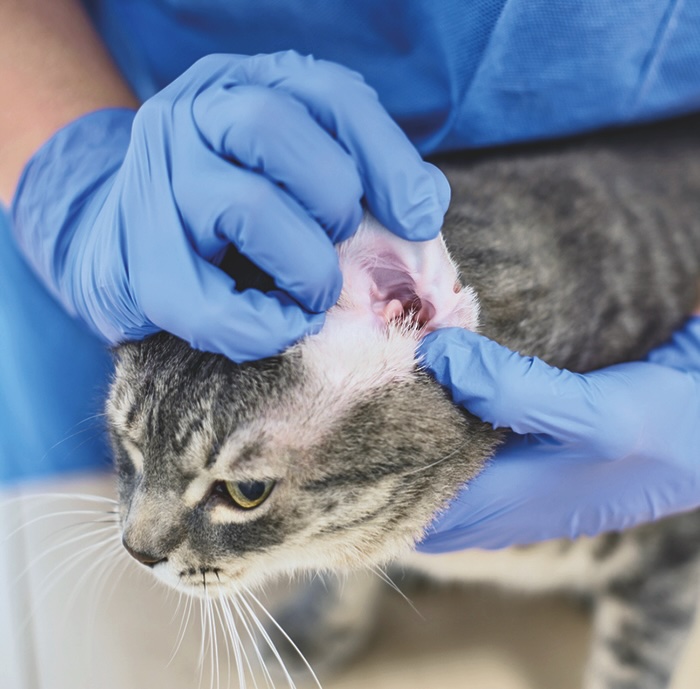
Cats can get tumors anywhere, including their ears. A tumor appearing on the visible part of your cat’s ear is easy to see, but tumors can develop deep in the ears. Because of this, these tumors are often not caught until the disease has significantly progressed. As such, it’s important to know what to watch for so you can seek help as soon as you see anything remotely suspicious.
Cancer (neoplasia) can occur anywhere on or in your cat’s ear. Cancerous lesions affecting the outer parts of the ear in cats are more common than tumors affecting the deeper portion of the ears. Tumors may be malignant or benign. Malignant tumors tend to be locally aggressive in cats’ ears and may metastasize to other parts of the body.
Signs that your cat may have a tumor deeper in the ear include pain and chronic ear infections that don’t respond well to medical therapy. Ear pain may be expressed in several different ways in cats, including hiding, rubbing the ear, shaking the head, tilting the head, crying or wincing when the ear is touched, and loss of appetite.
Squamous Cell Carcinoma
“The most common cancers we see affecting cats’ ears are sun-induced squamous cell carcinoma (SCC), cutaneous mast cell tumors (cMCT), and ceruminous gland adenocarcinoma,” says Tracy Gieger, DVM, ACVR, ACVIM, Clinical Professor in Radiation Oncology at Cornell University’s College of Veterinary Medicine. “SCC and cMCTs typically affect the pinna (outer ear flap), while adenocarcinomas typically occur deeper in the middle or inner ear.”
SCC most commonly occurs in older cats with short-haired white coats and lightly pigmented skin. These cats are more sensitive to sun exposure. The cancerous sore usually looks like redness, crusting, scabs, and ulcerated areas on the outer aspect of the pinnae. Some cats will have similar lesions around their eyes and on their nose.
“Tumors of the pinna can be treated with surgical excision (pinnectomy) or a superficial form of radiation therapy, Strontium-90 plesiotherapy. This allows delivery of a high dose of radiation to superficial lesions (3 to 4 mm deep) while sparing the ear pinna,” says Dr. Gieger. “This treatment is typically administered as a single treatment under general anesthesia and currently costs approximately $500 to $800 at Cornell.”
Cryosurgery (freezing) may be an option for small, superficial lesions. The prognosis for cats with SCC limited to the pinnae and appropriately treated is generally good, with long published survival times.
Mast Cell Tumors
Cutaneous MCTs can occur inside or on the outer surface of a cat’s ears. These tumors are easily identified by a simple procedure called fine needle aspiration with cytologic examination, which usually can be done without sedation.
While these MCTs in cats are often benign, surgical removal and biopsy is usually recommended to rule out malignancy and provide a cure for benign lesions. These tumors in cats usually look like individual small, smooth, pale pink, raised, oval or round skin masses.
Malignant Melanoma
Rarely, cats may get malignant melanomas in or on their ears. If you see a new deeply pigmented lesion on your cat, have it checked out as soon as possible. Although rare, melanoma in cats tends to be a very aggressive cancer.
Ceruminous Gland Adenocarcinoma
Of the tumors occurring more deeply in the ear of cats, ceruminous gland adenocarcinoma is the most common. This is a malignancy that requires aggressive treatment.
Diagnosis usually requires otoscopic examination under sedation or anesthesia, biopsy, and imaging of the ear with either X-rays or CT scan. Because this is an aggressive form of cancer, checking for evidence of metastasis (chest X-ray and aspiration of draining lymph node) is an important component of treatment planning.
“Treatment may include surgery (ventral bulla osteotomy, total ear canal ablation) or external-beam radiation therapy if surgery is not possible or if excision is incomplete,” says Dr. Gieger. “Cross-sectional imaging with CT scan is essential to determine treatment options; the cost of this at Cornell is approximately $3,000. The cost of radiation therapy ranges from $3,000 to $8,000, and the cost of surgery is $5,000 to $8,000.”
Prognosis for this aggressive cancer varies. Generally, the earlier it is caught and the more aggressively it is treated, the better the outcome.
By doing an otoscopic examination of the entire external ear canal during your regular wellness visits, your veterinarian may find disease before your cat starts showing clinical signs.
If your cat suffers from chronic ear infections, talking to your veterinarian about whether diagnostics to look for underlying neoplasia might be indicated.
Preventing SCC for short-haired white cats is key. Limit your cat’s sun exposure as much as possible and consider applying cat-safe sunscreen to the ears before sun exposure. Better yet, keep cats indoors whenever possible.
“The most common cancers we see affecting cats’ ears are sun-induced squamous cell carcinoma, cutaneous mast cell tumors, and ceruminous gland adenocarcinoma,” says Dr. Tracy Gieger.


